AI Appraisal Estimate

AI-generated estimates · not official valuations

From the user

What was submitted

Photo and notes provided by the user — not generated by AI

Submitted item photo
Submitted photo · June 3, 2026

User's notes

No additional notes provided.

AI analysis below

AI appraisal

AI analysis & estimate

AI-Generated · Verify before acting

Everything below is generated by AI for informational purposes only. AI can make mistakes — the AI may misidentify items or misattribute them (artist, maker, brand, designer, origin, era). This is not an official valuation and should not be used for insurance, sale, tax, estate, legal, or lending purposes — or any decision requiring a certified appraisal. It is not an authoritative claim about any person, brand, or rights holder — do not share or rely on it as a factual statement about a third party. Always consult qualified professionals before making financial decisions.

Read the full disclaimer

AI Identification

·Not independently authenticated·Verify before acting

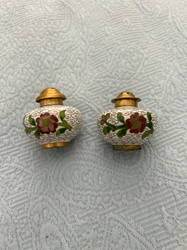
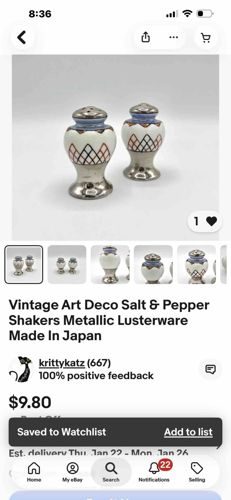
Vintage Art Deco Lusterware Salt and Pepper Shakers

Antique and Vintage Kitchenware / Decorative Arts

AI Estimated Value

·Not an official valuation·Verify before acting

$35.00 - $55.00

As of June 3, 2026

AI Item Analysis

·AI can make mistakes·Verify before acting
This is a pair of vintage ceramic salt and pepper shakers featuring a distinct Art Deco aesthetic, likely manufactured in Japan during the mid-20th century (circa 1930s-1950s). The shakers possess a classical urn-like silhouette with a wide, bulbous body tapering down to a flared pedestal base. The material is a white-glazed ceramic accented with metallic lusterware finishes. The lower pedestal and the domed caps are finished in a vibrant silver-tone metallic glaze, while a thin band of periwinkle blue circles the neck. The central body is decorated with an orange and black geometric trellis or diamond pattern, which is quintessential of the Art Deco period's geometric design language. Construction appears delicate, typical of exported Japanese pottery of the era. Condition-wise, the luster glaze shows minor surface wear and some light oxidation or dulling of the silver finish, which is common for aged metallic glazes. The hand-painted geometric lines show slight variability, indicating manual application. The holes on the caps are arranged in small clusters appropriate for fine-grained table salt and ground pepper. There are no immediate visible cracks or structural repairs, though slight shelf wear is evident on the bottom contact points.
AI Appraisal Report

·AI can make mistakes·Verify before acting
I have virtually examined this pair of Art Deco lusterware shakers. Based on the geometric trellis patterns and the specific periwinkle and silver luster glaze, these are consistent with 'Made in Japan' export ware from the 1930s. The silhouette and hand-painted application reflect the era's transition from traditional ceramics to mass-market decorative arts influenced by European modernism. My visual assessment identifies minor oxidation on the metallic glaze and light shelf wear, which is expected for mid-century lusterware. The absence of severe crazing or chipping maintains their collectibility, though the silver-tone finish shows typical 'rubbing' common to Japanese cold-painted or thin-fired accents. The market for Japanese lusterware is currently saturated but stable; collectors prioritize complete sets with original stoppers and vivid colors. These shakers are attractive but relatively common, limiting their value primarily to the 'vintage kitchenware' decorative market rather than high-end Art Deco galleries. Potential buyers usually look for these as accent pieces for curio cabinets or period-accurate table settings. Please note that this appraisal is based solely on digital images. A physical inspection is required to confirm the presence of any internal cracks, hidden repairs, or original manufacturer stamps (such as the Noritake green wreath or 'Hand Painted Japan' marks) which can influence value by 20-30%. Microscopic analysis of the silver glaze would be necessary to rule out modern reproductions, although the specific wear patterns seen here strongly suggest authentic mid-20th-century age.

Get your items appraised

Instant estimates of your treasures with AI-powered appraisals

Browse More Appraisals