These notes were written by the person who submitted this item. Appraiser.AI has not verified them, and the AI's identification and estimate may rely on them.
AI Estimated Value
Not an official valuation
$5 - $10
AI estimate as of November 10, 2025 · verify with a professional before acting
AI-Generated · Verify before acting
Everything on this page is generated by AI for informational purposes only. AI can make mistakes — the AI may misidentify items or misattribute them (artist, maker, brand, designer, origin, era). This is not an official valuation and should not be used for insurance, sale, tax, estate, legal, or lending purposes — or any decision requiring a certified appraisal. It is not an authoritative claim about any person, brand, or rights holder — do not share or rely on it as a factual statement about a third party. Always consult qualified professionals before making financial decisions.
This analysis also relies on unverified notes provided by the user, which may be incomplete or inaccurate and could affect the result.
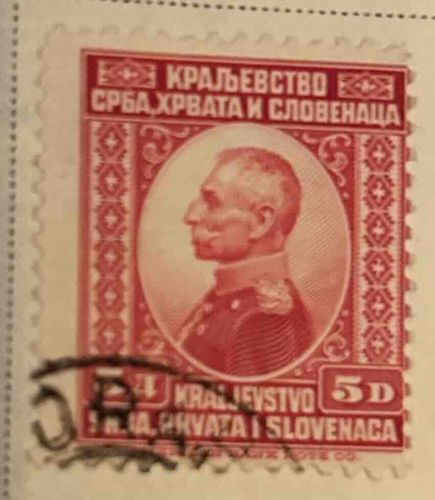
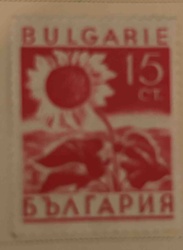
This item is a postage stamp from the historical Kingdom of Serbs, Croats, and Slovenes, which later became Yugoslavia. The stamp is predominantly red and white, printed on paper with a perforated edge, typical of postage stamps. The central motif features a profile portrait of a man, likely King Alexander I Karađorđević, facing left, enclosed within a white oval frame. He appears to be wearing a military uniform with a high collar and epaulets, indicative of his royal and military stature. The background directly surrounding the oval portrait is a lighter red, subtly patterned. The outer border of the stamp is a deeper red, adorned with intricate geometric and scrollwork patterns, and features text in both Cyrillic and Latin scripts. The top portion of the stamp bears the Cyrillic inscription "КРАЉЕВСТВО СРБА, ХРВАТА И СЛОВЕНАЦА" (Kingdom of Serbs, Croats, and Slovenes). The lower portion reiterates this in Latin script: "KRALJEVSTVO SRBA, HRVATA I SLOVENACA". In the bottom right corner, a rectangular box displays the denomination '5D', indicating a value of 5 Dinars. There is a clear circular black cancellation mark over the lower left part of the stamp, obscuring some of the text and the '5' in the denomination, signifying that the stamp has been used. The perforations around the edges are mostly intact, though some wear is visible. The overall condition suggests moderate use and age, with slight discoloration appropriate for an item of this vintage. The printing quality is good, showing clear detail in the portrait and text.
AI Appraisal Report
I have carefully examined the provided image of the Kingdom of Serbs, Croats, and Slovenes 5 Dinar stamp featuring King Alexander I. Based on the visual evidence, the stamp appears to be an authentic example of the issue from that period, likely from the definitive series featuring King Alexander I Karađorđević. The typography, portrait style, and perforation characteristics align with known examples of this stamp. The presence of a clear circular black cancellation mark indicates that the stamp is postally used. Its condition, with intact perforations but visible wear and age-appropriate discoloration, suggests a 'fine-used' to 'very-fine used' grade, though the cancellation does obscure some details.
In terms of market conditions, stamps from this era of Yugoslavian history are generally not considered rare, especially common definitive issues like this one. While it holds historical interest, the supply of these stamps is relatively abundant. Comparable examples of this specific 5 Dinar denomination in used condition typically fetch modest prices in the philatelic market.
Factors impacting value include its used condition, which is less desirable than unused examples, and the partial cancellation obscuring some of the design and denomination. There is a consistent, but not high, demand from collectors specializing in European or Yugoslavian philately.
It is important to note the limitations of appraising solely from an image. While the visual indicators are strong, a definitive authentication would require an in-person examination to verify paper type, watermark (if any), gum condition (if unused), printing methods, and to rule out any potential for reprints or forgeries which are occasionally present for older issues. Physical inspection also allows for a more precise assessment of perforations and any subtle flaws. Without provenance documentation or scientific testing, I cannot definitively guarantee 100% authenticity, but the visual evidence is strongly suggestive.