AI estimate as of November 10, 2025 · verify with a professional before acting
AI-Generated · Verify before acting
Everything on this page is generated by AI for informational purposes only. AI can make mistakes — the AI may misidentify items or misattribute them (artist, maker, brand, designer, origin, era). This is not an official valuation and should not be used for insurance, sale, tax, estate, legal, or lending purposes — or any decision requiring a certified appraisal. It is not an authoritative claim about any person, brand, or rights holder — do not share or rely on it as a factual statement about a third party. Always consult qualified professionals before making financial decisions.
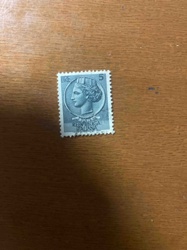
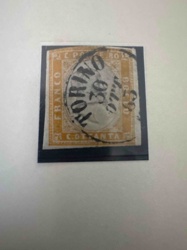
This item is a vintage Greek postage stamp, denominated at 25 Lepta. The stamp features a central vignette depicting a classical allegorical figure, likely Nike (Victory), standing between two architectural columns. The figure is portrayed with wings and draped garments, holding what appears to be a wreath or crown in her extended left hand. The overall design evokes classical Greek architecture and mythology, with the figure positioned under a pediment-like structure. The word "EΛΛΑΓ" (Hellas – Greece) is prominently displayed across the top, while the denomination "25 ΛΕΓΓΑ 25" (25 Lepta 25) is clearly visible at the bottom. The stamp exhibits a pale blue or grayish-blue ink on a lighter, possibly off-white or yellowish paper base. The edges appear perforated, characteristic of postage stamps. Visible condition issues include a dark, horizontal cancellation mark passing through the center of the design, indicating that the stamp has been used. This cancellation mark obscures some details of the central figure. The paper shows some discoloration consistent with age, and minor wear around the edges, though specific tears or significant damage are not clearly discernible from the image. The style is indicative of early 20th-century philately, likely dating to the first half of the 20th century. The craftsmanship is typical for engraved or lithographed stamps of that era, showing fine lines and details despite the small scale.
AI Appraisal Report
I have examined the provided image of the Greek 25 Lepta Stamp (Victory/Nike). Based on its visual characteristics, it appears to be a genuine used example of what is likely a common definitive issue from Greece, possibly dating from the early 20th century. The design, featuring Nike between columns, is consistent with known Greek philatelic issues of that period. The perforation and 'EΛΛΑΓ' and '25 ΛΕΓΓΑ 25' inscriptions further support its authenticity as a legitimate postage stamp.
Regarding condition, the stamp shows a clear, dark, horizontal cancellation mark, indicating it has been postally used. This cancellation obscures parts of the central design, which generally reduces value. There's visible age-related discoloration on the paper, and some wear consistent with its age and use. While no major tears are evident from the image, minor imperfections are common in used stamps of this era. Overall, I would rate its condition as 'Fine Used' to 'Very Fine Used,' depending on the severity of the unobservable wear.
From a market perspective, common definitive stamps from this period, even with classical designs, typically do not command high prices when in used condition like this. Demand for such items is steady among generalists and thematic collectors (e.g., 'Olympics on stamps,' 'Greek mythology on stamps'), but not intense enough to drive significant value given the apparent commonality. Rarity is low for this type of issue.
Factors impacting its value include its used condition, the heavy cancellation, and its likely high print run. For a full authentication and more precise condition assessment, a physical examination would be necessary to verify paper type, exact perforation count, watermarks (if any), gum condition (if unused), and to detect any thin spots, repairs, or hidden faults not visible in the image. Provenance, if available, could add minor value, but is unlikely for such a common item. Without in-person inspection, this appraisal is based solely on visual attributes as presented.