These notes were written by the person who submitted this item. Appraiser.AI has not verified them, and the AI's identification and estimate may rely on them.
AI Estimated Value
Not an official valuation
$20-40
AI estimate as of December 6, 2025 · verify with a professional before acting
AI-Generated · Verify before acting
Everything on this page is generated by AI for informational purposes only. AI can make mistakes — the AI may misidentify items or misattribute them (artist, maker, brand, designer, origin, era). This is not an official valuation and should not be used for insurance, sale, tax, estate, legal, or lending purposes — or any decision requiring a certified appraisal. It is not an authoritative claim about any person, brand, or rights holder — do not share or rely on it as a factual statement about a third party. Always consult qualified professionals before making financial decisions.
This analysis also relies on unverified notes provided by the user, which may be incomplete or inaccurate and could affect the result.
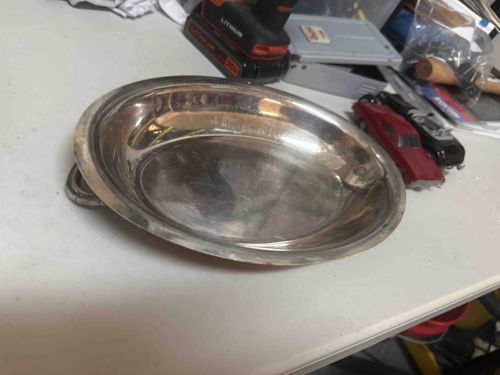
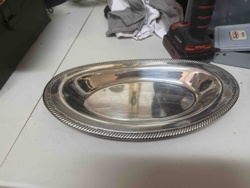
This is an oval-shaped serving dish, likely constructed from a base metal and then silver-plated, given its shiny metallic appearance and the typical wear patterns seen in such items. The dish has a relatively shallow depth, consistent with its function as a serving piece, possibly for vegetables, side dishes, or entrees. It features a moderately wide, raised rim bordering the main serving area, which adds to its classic aesthetic and provides a comfortable edge for handling. There are small, integrated handles on the shorter sides of the oval, suggesting it's designed for easy transport from kitchen to table. The color is a bright, reflective silver, though there are visible signs of tarnish and scratching throughout the surface, particularly in the interior and along the rim. This suggests regular use and handling over time. The tarnish appears as darker, duller areas, especially in recessed curves and edges, indicating that the silver plating is largely intact but in need of polishing. There are no readily visible maker's marks, engravings, or intricate patterns in the image. The overall style appears to be a functional, yet elegant, design often found in tableware from the mid-20th century. The craftsmanship seems solid and utilitarian, prioritizing function, although the plating indicates a certain level of refinement for formal or semi-formal dining. The scratches and tarnish are consistent with an item that has been used and stored over several years, but does not show overt damage like dents or significant plating loss.
AI Appraisal Report
Upon examining the images provided, I've assessed this silver-plated oval serving dish. The piece presents as a typical mid-20th-century American or European tableware item. Its utilitarian yet elegant design, with integrated handles and a simple raised rim, was common for household use. The condition is fair to good for its age and likely function; while there are no major dents or structural damage visible, the surface exhibits noticeable tarnish and numerous scratches from regular use and cleaning. These are cosmetic issues but significantly impact its market desirability.
The value of silver-plated hollowware is considerably lower than that of sterling silver. The market is saturated with similar mass-produced, unmarked serving pieces. Demand is generally low, driven primarily by buyers seeking functional, inexpensive items for entertaining rather than by collectors. Based on recent sales of comparable unmarked silver-plated serving dishes in similar condition on secondary markets like online auctions and estate sales, the current market value is modest.
It is important to note that this appraisal is based solely on visual examination of the provided images. A definitive valuation and authentication require in-person inspection. This would involve searching for any faint or hidden maker's marks that could identify a notable manufacturer (e.g., Reed & Barton, Gorham, Christofle), which could alter the value. Without physical confirmation of a maker's mark or provenance, the item is appraised as a generic, decorative, and functional piece.