These notes were written by the person who submitted this item. Appraiser.AI has not verified them, and the AI's identification and estimate may rely on them.
AI Estimated Value
Not an official valuation
$150-250 for the set
AI estimate as of December 6, 2025 · verify with a professional before acting
AI-Generated · Verify before acting
Everything on this page is generated by AI for informational purposes only. AI can make mistakes — the AI may misidentify items or misattribute them (artist, maker, brand, designer, origin, era). This is not an official valuation and should not be used for insurance, sale, tax, estate, legal, or lending purposes — or any decision requiring a certified appraisal. It is not an authoritative claim about any person, brand, or rights holder — do not share or rely on it as a factual statement about a third party. Always consult qualified professionals before making financial decisions.
This analysis also relies on unverified notes provided by the user, which may be incomplete or inaccurate and could affect the result.
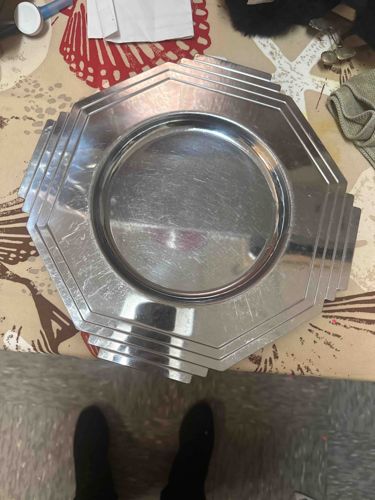
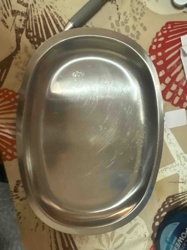
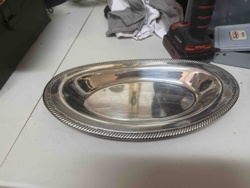
This item is a set of several stacked octagonal metal serving platters or charger plates, exhibiting a clear Art Deco design influence. Each plate features a central circular depression, likely for holding a dinner plate or serving food, surrounded by a broad, flat, octagonal rim. The most distinctive feature is the stepped or grooved pattern on the outermost edges of the octagonal rim, which creates a layered, geometric aesthetic characteristic of the Art Deco period. The material appears to be a polished silver-toned metal, possibly stainless steel, chrome-plated metal, or polished aluminum, given the reflective surface and light-gray metallic hue. The finish is shiny but shows numerous superficial scratches, scuffs, and abrasions across the surfaces, particularly on the central circular area and the flat octagonal rims, indicating regular use and handling over time. There are no visible maker's marks, signatures, or stamps discernible from the image. The construction appears to be solid and robust, suggesting good craftsmanship despite the surface wear. The overall style points to an estimated age from the 1920s to the 1940s, aligning with the Art Deco movement. These pieces would have been used for formal dining as underplates for dinnerware or as stylish serving dishes. The stacking suggests they are designed to be a set.
AI Appraisal Report
Upon examining the provided images of this set of Art Deco octagonal serving platters or charger plates, I have conducted my appraisal. The design is a quintessential example of the Art Deco style, popular from the 1920s to the 1940s, characterized by the strong geometric form, octagonal shape, and stepped, grooved rim. The material appears to be a polished silver-toned metal, likely chrome-plated metal, stainless steel, or possibly aluminum, consistent with materials used during that era.
The condition, as observed from the images, is fair to good, showing considerable surface wear. There are numerous superficial scratches, scuffs, and abrasions across all surfaces, which is typical for vintage serving ware and indicates a history of regular use. These condition issues are the primary factor limiting the value. The absence of a visible maker's mark (such as Chase, Farberware, or Manning Bowman) also significantly impacts the appraisal, as signed pieces by noted designers or manufacturers command much higher prices in the current market.
Comparable unsigned Art Deco chrome or stainless steel charger sets in similar used condition typically sell in the range of $150 to $250. While the design is stylish and desirable, the market is well-supplied with similar items, making them not particularly rare. Demand exists among enthusiasts of the Art Deco period and those seeking authentic period decor, but the highest values are reserved for pieces in excellent condition or with a known provenance.
It is crucial to note the limitations of an appraisal based solely on images. A physical, in-person examination would be required to definitively identify the metal composition, assess the depth of the scratches, and search for any faint or hidden maker's marks that are not visible in the photographs. Verifying the material and searching for a signature are essential steps for a full and conclusive authentication and valuation.