AI Appraisal Estimate

AI-generated estimates · not official valuations

From the user

What was submitted

Photo and notes provided by the user — not generated by AI

Submitted item photo
Submitted photo · June 6, 2026

User's notes

No additional notes provided.

AI analysis below

AI appraisal

AI analysis & estimate

AI-Generated · Verify before acting

Everything below is generated by AI for informational purposes only. AI can make mistakes — the AI may misidentify items or misattribute them (artist, maker, brand, designer, origin, era). This is not an official valuation and should not be used for insurance, sale, tax, estate, legal, or lending purposes — or any decision requiring a certified appraisal. It is not an authoritative claim about any person, brand, or rights holder — do not share or rely on it as a factual statement about a third party. Always consult qualified professionals before making financial decisions.

Read the full disclaimer

AI Identification

·Not independently authenticated·Verify before acting

Collection of Mid-20th Century African Colonial and Post-Colonial Postage Stamps

Philately / Collectible Postage Stamps

AI Estimated Value

·Not an official valuation·Verify before acting

$15 - $25

As of June 6, 2026

AI Item Analysis

·AI can make mistakes·Verify before acting
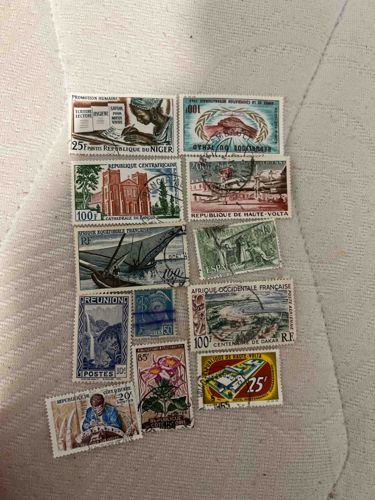
A group of eleven assorted postage stamps primarily from former French African colonies and territories, dating from roughly the 1940s through the 1960s. The collection includes issues from Republic of Niger, Republic of Ivory Coast (Côte d'Ivoire), Republic of Upper Volta (Haute-Volta), Central African Republic, Réunion Island, and French West Africa (Afrique Occidentale Française). The stamps are printed on perforated paper and feature a variety of colors and printing methods, including line engraving and offset lithography. Subject matter varies from local architecture (Cathédrale de Bangui) and flora/fauna to cultural themes like literacy and international cooperation (UN/ILO). Several stamps exhibit circular date stamps (CDS) or 'canceled-to-order' (CTO) markings, indicating they have been used or processed for collectors. The condition appears mixed; most stamps show intact perforations, though some exhibit minor yellowing or subtle edge wear consistent with age and previous mounting in an album. There are no signs of significant tearing, but the cancelations vary in clarity. The collection represents the transitional period of African decolonization, featuring both colonial-era designs and early independence issues. Notable is a 'Centenary of Dakar' stamp (1857-1957) from French West Africa and a 'Promotion Humaine' stamp from Niger highlighting education. The craftsmanship reflects the classic European-influenced engraving style typical of 20th-century philately.

AI Appraisal Report

·AI can make mistakes·Verify before acting
I have conducted a visual examination of this collection of eleven mid-20th-century African colonial and post-colonial stamps. The group includes issues from the Republic of Niger, Ivory Coast, Upper Volta, and French West Africa, representing the critical 'Grand Dépendance' era of the 1950s and 60s. Condition is generally fair to good, with intact perforations and vibrant colors; however, the presence of heavy Circular Date Stamps (CDS) and potential Canceled-to-Order (CTO) markings indicates these are used or philatelically processed rather than mint-never-hinged (MNH) specimens, which limits their premium value. While these stamps feature the celebrated line-engraved craftsmanship of European masters like Gandon or Decaris, they are common issues that were printed in high volumes for both local postal use and the international collector market. Market demand for common thematic stamps of the Francophone regions remains steady but modest. Similar small lots of used Francophone African stamps typically realize between $1 and $3 per stamp on the secondary market. The 'Centenary of Dakar' and the Central African Republic architecture issues are historically significant but abundant in the philatelic trade. Authenticity appears consistent with the paper type and engraving styles of the period. However, a definitive valuation is limited by the digital nature of this inspection. A physical examination is required to verify watermarks, paper thickness, and the presence of gum or hinge remnants on the reverse. Scientific testing (UV light) would be necessary to detect hidden repairs or 'faked' cancellations. For a complete authentication, provenance regarding the original album mounting would be beneficial. Given the current information, the value reflects a starter collection or a thematic reference lot.

Get your items appraised

Instant estimates of your treasures with AI-powered appraisals

Browse More Appraisals