AI estimate as of October 24, 2025 · verify with a professional before acting
AI-Generated · Verify before acting
Everything on this page is generated by AI for informational purposes only. AI can make mistakes — the AI may misidentify items or misattribute them (artist, maker, brand, designer, origin, era). This is not an official valuation and should not be used for insurance, sale, tax, estate, legal, or lending purposes — or any decision requiring a certified appraisal. It is not an authoritative claim about any person, brand, or rights holder — do not share or rely on it as a factual statement about a third party. Always consult qualified professionals before making financial decisions.
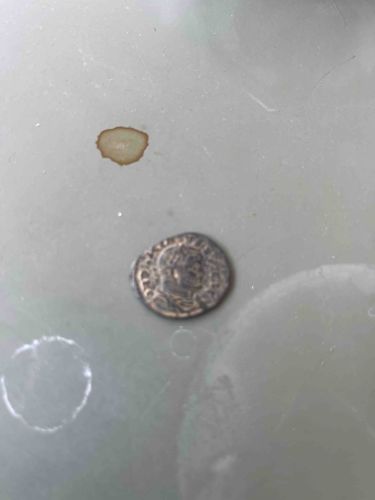
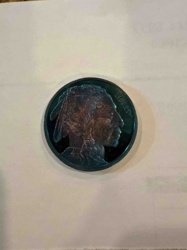
The item appears to be a small, circular metal coin, likely ancient in origin, possibly Roman or Greek, given the visible iconography. Its diameter seems to be approximately that of a small modern coin, perhaps a dime or penny, though precise dimensions are not ascertainable from the image. The material is a dark, oxidized metal, possibly bronze, copper, or a silver alloy that has tarnished significantly over time. The color is predominantly a dark bronze or greyish-brown with areas of lighter metallic sheen peeking through. It features a raised design on at least one side, which appears to be a bust or head in profile, surrounded by what might be an inscription or a decorative border. Details of the facial features are somewhat indistinct due to wear and patination, but a discernible outline of a head with hair or a headdress is present. The edges of the coin exhibit a rough, perhaps irregular, texture, which could be indicative of ancient minting techniques. There are no clear identifying marks such as dates, mint marks, or full inscriptions visible in the provided image. The overall condition suggests significant age and exposure, with surface wear, corrosion, and a natural patina that has developed over centuries. There are no obvious signs of recent damage, repairs, or cleaning; the patination appears consistent with undisturbed aging. The craftsmanship, while difficult to fully assess without clearer images, reflects the typical style of ancient coinage with a central portrait and surrounding elements, indicating it is a genuine artifact rather than a modern replica, although a definitive statement on authenticity would require in-hand examination. The piece possesses an aged aesthetic, typical of excavated or long-circulated ancient currency.
AI Appraisal Report
Based on my visual examination of the provided image, this ancient coin, likely Roman or Greek due to the portraiture style and apparent age, appears to be an authentic artifact rather than a modern replica. The dark, oxidized patina, rough edges, and indistinct features are consistent with centuries of wear and exposure typical of excavated or long-circulated ancient currency. The craftsmanship, though difficult to fully discern, exhibits the characteristics of ancient minting techniques.
Condition is fair, showing significant wear, corrosion, and patination. While this indicates genuine age, it also limits the ability to identify specific details crucial for higher valuations. Market conditions for unidentified ancient bronze/copper coins in this condition are generally modest. Comparables would include 'unidentified Roman bronze' or similarly worn Greek regional issues. Demand exists, but the lack of clear identification, such as a specific emperor or city, limits its appeal to general collectors rather than specialists.
Factors significantly impacting this value are the heavily worn surface, which obscures definitive identification, and the commonality of bronze coinage from these periods. Rarity is difficult to assess without identification, but common types in this condition do not command high prices.
It is imperative to state that without in-person examination, definitive authenticity cannot be 100% guaranteed. A physical inspection would allow for examination of weight, precise diameter, thickness, metallic composition analysis (e.g., XRF), and detailed assessment of strike and edge characteristics. Clearer photography, especially under varied lighting, could also aid in initial identification. Furthermore, any provenance documentation would significantly enhance value and confirm authenticity.