AI estimate as of October 17, 2025 · verify with a professional before acting
AI-Generated · Verify before acting
Everything on this page is generated by AI for informational purposes only. AI can make mistakes — the AI may misidentify items or misattribute them (artist, maker, brand, designer, origin, era). This is not an official valuation and should not be used for insurance, sale, tax, estate, legal, or lending purposes — or any decision requiring a certified appraisal. It is not an authoritative claim about any person, brand, or rights holder — do not share or rely on it as a factual statement about a third party. Always consult qualified professionals before making financial decisions.
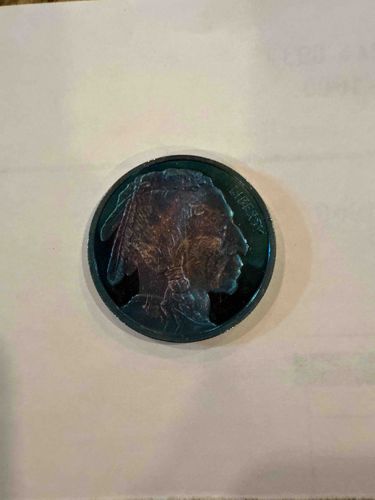
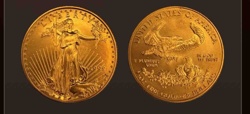
The item appears to be a Buffalo Nickel, or a round/replica designed to resemble one, exhibiting striking artificial or natural toning. The coin's obverse features the iconic profile of a Native American chief, facing right, with details such as his braided hair and feather headdress visible. The word "LIBERTY" is partially discernable along the upper right rim of the coin. The most prominent characteristic is the vibrant, iridescent toning covering the entire surface of the coin, shifting through shades of deep metallic blues, purples, and hints of coppery-gold in the central relief, suggesting a strong environmental reaction or an intentional chemical application to achieve this colorful patination. The toning appears relatively even across the surface, although the higher points of the relief show more of the underlying metallic color, indicating some wear or perhaps a less intense toning in those areas. The rim of the coin is clearly defined, and while some wear is visible on the high points of the chief's effigy, the overall details of the design are still quite sharp. The material is likely a copper-nickel alloy if it is an authentic Buffalo Nickel, or a base metal alloy if it's a replica round. Given the intense and multi-hued coloration, the toning is likely artificial, a common practice among collectors to enhance visual appeal, or a result of specific storage conditions. Without seeing the reverse, it's difficult to confirm authenticity or specific mintage, but the visible obverse design is consistent with the Type I or Type II Buffalo Nickels minted between 1913 and 1938. The craftsmanship of the original design is high, a recognized work by James Earle Fraser. The condition presents a unique aesthetic due to the toning, which would be a significant factor in its collectibility and value, positively if natural, potentially negatively if unprofessionally artificial.
AI Appraisal Report
I have examined the provided image of what appears to be a Toned Buffalo Nickel or a similar replica. The obverse displays the iconic Native American chief design, and the word "LIBERTY" is partially visible. The most striking feature is the intense, multi-hued iridescent toning, exhibiting shades of blue, purple, and coppery-gold. This coloration strongly suggests artificial toning, as it is unusually vibrant and evenly distributed, often achieved through chemical treatment rather than natural environmental exposure. While natural toning can be desirable, such extreme artificial toning typically diminishes a coin's numismatic value, as it is not original.
Authenticity is difficult to ascertain from an image alone. While the design aligns with a Buffalo Nickel, without examining the reverse, edge, weight, and metallic composition, it's impossible to confirm if it's an authentic nickel or a base metal replica/round. The visible wear on higher points suggests circulation if genuine. Market demand for artificially toned coins is generally low among serious collectors, who prioritize originality and natural patination. However, some casual collectors might find the aesthetics appealing, but this doesn't translate to significant value.
Factors significantly impacting value are the likely artificial nature of the toning (negative) and the uncertainty of its authenticity (negative). If this were a naturally toned, authentically rare Buffalo Nickel in similar condition, its value would be significantly higher. Given the strong likelihood of artificial toning and the inability to confirm authenticity, I estimate its value in the range of $5-$20. This assumes it's a genuine Buffalo Nickel with artificial toning; if proven to be a replica, its value would be negligible. Full authentication would require in-person examination, including detailed inspection under magnification, weighing, metallurgical analysis, and potentially XRF testing to verify material composition.