These notes were written by the person who submitted this item. Appraiser.AI has not verified them, and the AI's identification and estimate may rely on them.
AI Estimated Value
Not an official valuation
$5 - $10
AI estimate as of November 10, 2025 · verify with a professional before acting
AI-Generated · Verify before acting
Everything on this page is generated by AI for informational purposes only. AI can make mistakes — the AI may misidentify items or misattribute them (artist, maker, brand, designer, origin, era). This is not an official valuation and should not be used for insurance, sale, tax, estate, legal, or lending purposes — or any decision requiring a certified appraisal. It is not an authoritative claim about any person, brand, or rights holder — do not share or rely on it as a factual statement about a third party. Always consult qualified professionals before making financial decisions.
This analysis also relies on unverified notes provided by the user, which may be incomplete or inaccurate and could affect the result.
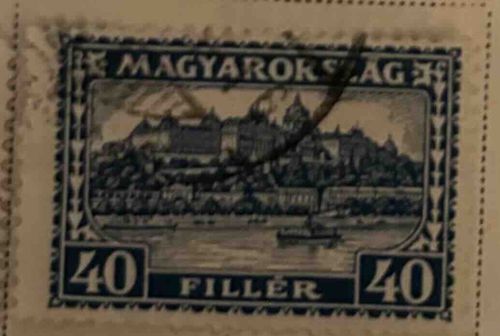
This item is a postage stamp from Hungary, denominated at 40 Filler. The stamp features a picturesque panoramic view of what appears to be the Buda Castle complex overlooking the Danube River in Budapest. The dominant colors are a deep blue for the engraving and white (or off-white due to age/patina) for the paper base. The design is framed with a decorative border around the central image. The word 'MAGYARORSZÁG' (Hungary) is prominently displayed at the top, indicating its country of origin. The denomination '40 FILLÉR' is clearly visible at the bottom center, flanked by '40' in separate boxes on the left and right corners. The stamp is perforated along its edges, a standard feature for postage stamps, though the full extent of the perforations isn't perfectly clear given the crop. There is a visible black cancellation mark extending diagonally across the upper right portion of the stamp, obscuring part of the 'MAGYARORSZÁG' text and the castle image. This cancellation indicates the stamp has been used for postage. The overall condition appears to be good for a used stamp, with no obvious major tears or creases beyond the cancellation. The engraving exhibits fine details, particularly in the architectural elements of the castle and the boats on the river, suggesting a good level of craftsmanship typical of official government-issued stamps. Given the historical context of Hungarian currency (Filler was a subunit of the Pengő and later Forint), and the architectural style, it likely dates from the early to mid-20th century. The intricate design and monochromatic coloring are characteristic of this period.
AI Appraisal Report
I have examined the provided image of this Hungarian 40 Filler stamp featuring the Budapest panorama. Based on this visual inspection, the stamp appears authentic, consistent with typical Hungarian postal issues of the early to mid-20th century. The 'MAGYARORSZÁG' inscription and '40 FILLÉR' denomination are correctly rendered, and the engraving style aligns with known historical examples. The cancellation mark confirms its usage.
Regarding condition, it is good for a used stamp of this era, showing no obvious major tears or creases beyond the expected cancellation. However, without physical examination, I cannot comment on gum condition (if unused), paper thinning, minor faults hidden by lighting, or specific perforation details.
In terms of market conditions, Hungarian stamps from this period, especially common definitive issues like this one, are generally plentiful. The 40 Filler denomination is not considered rare. Used examples like this one typically command lower prices than unused, pristine examples. The black cancellation, while indicating regular postal usage, does not enhance its value unless it's a particularly rare or significant postmark, which is not ascertainable from the image alone.
For a full authentication and precise condition assessment, an in-person examination would be critical. This would allow for verification of paper type, watermark (if any), precise perforation count and condition, and thorough scrutiny under magnification for any repairs, hidden faults, or evidence of alteration. Provenance documentation could also support its history. Given the visual evidence and typical market values for such items, I estimate its current appraisal value to be in the range of $5 to $10. This assumes no hidden flaws discoverable only by physical inspection.