AI Appraisal Estimate

AI-generated estimates · not official valuations

From the user

What was submitted

Photo and notes provided by the user — not generated by AI

Submitted item photo
Submitted photo · May 27, 2026

User's notes

No additional notes provided.

AI analysis below

AI appraisal

AI analysis & estimate

AI-Generated · Verify before acting

Everything below is generated by AI for informational purposes only. AI can make mistakes — the AI may misidentify items or misattribute them (artist, maker, brand, designer, origin, era). This is not an official valuation and should not be used for insurance, sale, tax, estate, legal, or lending purposes — or any decision requiring a certified appraisal. It is not an authoritative claim about any person, brand, or rights holder — do not share or rely on it as a factual statement about a third party. Always consult qualified professionals before making financial decisions.

Read the full disclaimer

AI Identification

·Not independently authenticated·Verify before acting

Ceramiche Umbre Hand-Painted Italian Majolica Plate

Antique/Vintage Italian Ceramics

AI Estimated Value

·Not an official valuation·Verify before acting

$45.00 - $75.00

As of May 27, 2026

AI Item Analysis

·AI can make mistakes·Verify before acting
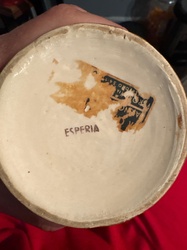
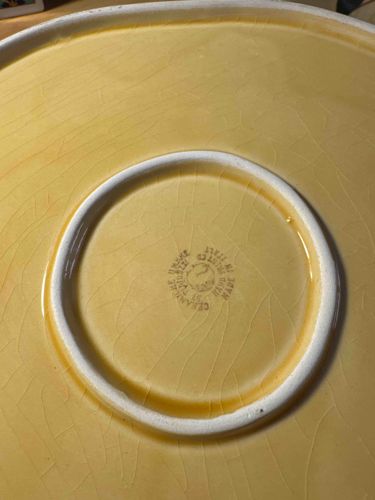
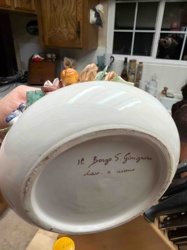
This item is a hand-painted ceramic plate featuring a vibrant ocher or mustard yellow glaze. The craftsmanship is attributed to Ceramiche Umbre (S.T. Passignano), an Italian pottery studio located in the Umbria region, noted for its traditional majolica techniques. The plate features a circular unglazed foot ring, which shows the white earthenware body beneath. A defining characteristic of this piece is the extensive 'crazing' across the glazed surface—a network of fine hairline cracks caused by the different expansion rates of the clay body and the glaze during the firing process. While common in vintage Italian ceramics, this condition indicates significant age or thermal shock exposure. The central mark on the reverse is a circular black stamp that reads 'CERAMICHE UMBRE ST PASSIGNANO' around a central logo, with 'HAND PAINTED MADE IN ITALY' visible at the bottom. The glaze thickness appears uneven, which is a hallmark of hand-dipped or hand-applied artisanal production. There is minor stilt marking and some dark particulate matter trapped within the glaze, typical of rustic kiln environments. This piece likely dates from the mid-to-late 20th century, representing the mid-century revival of Italian regional pottery styles.
AI Appraisal Report

·AI can make mistakes·Verify before acting
I have examined the digital images of the Ceramiche Umbre (S.T. Passignano) Majolica plate. The piece exhibits characteristic traits of mid-20th-century Italian regional pottery, specifically the vibrant ocher glaze and rustic application techniques typical of the Umbria region. The 'Ceramiche Umbre' stamp is consistent with authentic marks from the Passignano studio during the 1950s–1970s. The extensive crazing, while common in majolica due to differential expansion coefficients, is quite pronounced here. While some collectors appreciate this 'crackle' for its vintage aesthetic, severe crazing can lead to glaze flaking or interior staining, slightly tempering the market value. Market demand for mid-century Italian ceramics remains steady but highly price-sensitive for utilitarian or decorative plates of this size. Comparables for standard Ceramiche Umbre plates typically fluctuate between $30 and $90 depending on the complexity of the hand-painted design; the monochrome yellow glaze makes this a more minimalist, decorative piece rather than a high-end collector's focal point. Factors such as the visible kiln stilt marks and trapped particulates confirm its artisanal, hand-crafted origin. Limitations: My assessment is based solely on photographic evidence. I cannot verify the physical 'ring' of the ceramic to check for internal structural cracks hidden by the crazing, nor can I confirm the presence of professional restorations under UV light. A full authentication would require a physical inspection to assess the weight, tactile texture of the glaze, and verification of any repair work. Provenance documentation, such as original purchase receipts or gallery records, would further solidify its history but would not significantly elevate the valuation beyond current market trends for this maker.

Get your items appraised

Instant estimates of your treasures with AI-powered appraisals

Browse More Appraisals