AI Appraisal Estimate

AI-generated estimates · not official valuations

From the user

What was submitted

Photo and notes provided by the user — not generated by AI

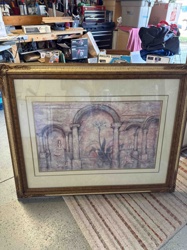
Submitted item photo
Submitted photo · June 13, 2026

User's notes

No additional notes provided.

AI analysis below

AI appraisal

AI analysis & estimate

AI-Generated · Verify before acting

Everything below is generated by AI for informational purposes only. AI can make mistakes — the AI may misidentify items or misattribute them (artist, maker, brand, designer, origin, era). This is not an official valuation and should not be used for insurance, sale, tax, estate, legal, or lending purposes — or any decision requiring a certified appraisal. It is not an authoritative claim about any person, brand, or rights holder — do not share or rely on it as a factual statement about a third party. Always consult qualified professionals before making financial decisions.

Read the full disclaimer

AI Identification

·Not independently authenticated·Verify before acting

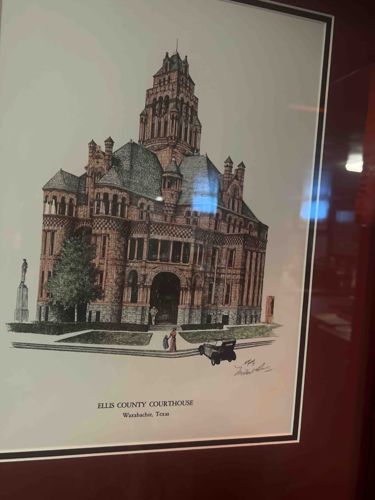
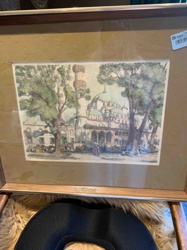
Framed Architectural Illustration of the Ellis County Courthouse

Framed Art & Architectural Prints

AI Estimated Value

·Not an official valuation·Verify before acting

$150 - $250

As of June 13, 2026

AI Item Analysis

·AI can make mistakes·Verify before acting
This is a matted and framed architectural illustration depicting the historic Ellis County Courthouse located in Waxahachie, Texas. The artwork is executed in an ink-heavy style, likely a lithograph or a high-quality print of a pen-and-ink drawing with watercolor or digital tinting. The piece features the iconic Richardsonian Romanesque architecture of the building, complete with its towering clock steeple, sandstone-and-granite textures, and arched entryways. In the foreground, there are vintage-style details including a figure in turn-of-the-century attire and a classic early 20th-century motorcar, suggesting a nostalgic or historical commemorative style. The print includes a lower-center title 'ELLIS COUNTY COURTHOUSE, Waxahachie, Texas' and an artist's signature in the lower right, which appears to be 'M. Miller' or similar. The framing is professional, featuring a double mat—a dark inner mat and a wider light-colored outer mat—enclosed in a dark burgundy or mahogany-toned wood frame. The condition appears to be excellent with no visible foxing, yellowing, or paper waviness. The crispness of the lines and the uniformity of the color suggest a contemporary production period, likely late 20th or early 21st century. The craftsmanship of the illustration shows high attention to perspective and architectural accuracy, capturing the grandeur of James Riely Gordon's original 1895 design.
AI Appraisal Report

·AI can make mistakes·Verify before acting
I have carefully examined the provided visual details of the framed architectural illustration of the Ellis County Courthouse. The piece presents as a contemporary commemorative print, likely a high-quality lithograph or offset print of a pen-and-ink original. The condition appears excellent; the double matting is crisp, and the mahogany-toned frame shows no significant abrasions. The illustration captures James Riely Gordon’s Richardsonian Romanesque design with high technical proficiency, though the uniform color saturation suggests a modern production rather than a period watercolor. The market for regional architectural prints is stable but niche. This specific piece appeals primarily to residents of Waxahachie, Texas, or collectors of Texas courthouse memorabilia. Comparable framed prints of regional landmarks typically trade in the $100 to $300 range at boutique galleries or estate auctions. The inclusion of a signature (likely 'M. Miller') adds some value, though it represents a commercial artist rather than a high-profile fine artist, which limits the secondary market ceiling. Several limitations exist in this digital appraisal. I cannot verify the substrate (paper type), the presence of acid-free archival materials (which affects long-term value), or whether the signature is hand-signed or part of the printed plate. A physical inspection is required to determine the print method (e.g., checking for a halftone dot pattern under magnification) and to assess the frame's integrity. To fully authenticate this as a limited edition or original work, I would require provenance documentation or a certificate of authenticity from the artist or publishing house. Without physical access to the reverse of the frame, I cannot identify any manufacturer stamps or specific production dates.

Get your items appraised

Instant estimates of your treasures with AI-powered appraisals

Browse More Appraisals