These notes were written by the person who submitted this item. Appraiser.AI has not verified them, and the AI's identification and estimate may rely on them.
AI Estimated Value
Not an official valuation
$150-300
AI estimate as of October 26, 2025 · verify with a professional before acting
AI-Generated · Verify before acting
Everything on this page is generated by AI for informational purposes only. AI can make mistakes — the AI may misidentify items or misattribute them (artist, maker, brand, designer, origin, era). This is not an official valuation and should not be used for insurance, sale, tax, estate, legal, or lending purposes — or any decision requiring a certified appraisal. It is not an authoritative claim about any person, brand, or rights holder — do not share or rely on it as a factual statement about a third party. Always consult qualified professionals before making financial decisions.
This analysis also relies on unverified notes provided by the user, which may be incomplete or inaccurate and could affect the result.
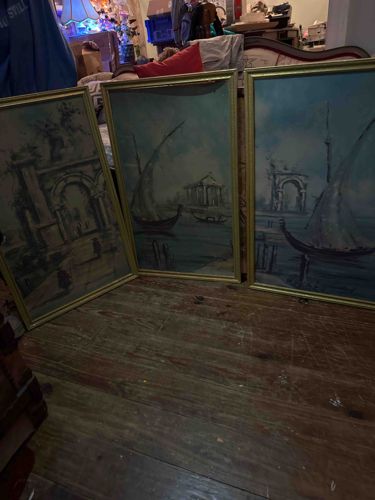
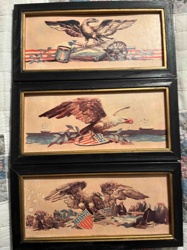
This item consists of a triptych, or a set of three framed artworks, attributed to De Corsi based on the provided context. Each piece is housed in a simple, likely wooden, gold-toned frame that appears to be gilded or painted in a metallic finish. The overall aesthetic of the frames suggests a mid-20th-century style, possibly from the 1950s or 1960s. The artwork itself depicts classical or Mediterranean scenes with architectural elements and sailing vessels, rendered in a muted, perhaps sepia-toned or monochromatic palette for the leftmost piece, and predominantly blues and grays for the two rightmost pieces, suggesting maritime or Venetian themes. The left artwork features a large arched structure, possibly a ruin or a classical building, with small figures adding scale. The two right artworks are more distinctly maritime, showcasing boats with sails on water, with classical-style architectural features (temple-like structures and arches) in the background. The style appears to be either prints (lithographs or engravings) or possibly paintings with a print-like quality, characterized by a somewhat faded or aged appearance. Given the identical framing and thematic consistency, these pieces were likely created and intended to be displayed as a set. The condition appears to be fair to good, with some visible dust and potential minor wear on the frames commensurate with age. There are no obvious signs of significant damage like tears or major discoloration visible in the image, but a closer inspection would be needed to confirm. The craftsmanship suggests commercially produced decorative art, designed to appeal to a broad audience interested in classical or nautical themes.
AI Appraisal Report
Upon examining this triptych attributed to "De Corsi," I observe three framed artworks depicting classical or Mediterranean maritime/architectural scenes. The frames are simple, gold-toned, and appear to be from the mid-20th century. The artworks themselves present a somewhat faded, print-like quality, with a sepia tone on the left and blues/grays dominating the right two pieces. The condition appears fair to good for decorative art of this age; I note some minor wear on the frames and dust, which is typical. There are no obvious signs of major damage visible in the image, such as tears or significant water damage, but a hands-on inspection would be crucial to confirm this.
Regarding authenticity, the attribution to "De Corsi" is noted. However, without further information, this name is quite common in decorative art from the mid-20th century, often associated with commercial prints rather than fine art paintings by a single prominent artist. Many such names were used for mass-produced items. Therefore, it is highly probable these are decorative prints rather than original paintings by a recognized artist.
Market conditions for such decorative triptychs are generally stable but not high. Comparables typically involve similar framed decorative prints from the mid-century period, often found in estate sales or online marketplaces. Demand exists for decorative items that fit specific aesthetics, but rarity is low due to their likely mass-produced nature. Factors impacting value include the decorative appeal as a set, the fair condition, and the likely print medium. If these were authenticated as original oil paintings by a known, listed artist named De Corsi, the value would be significantly higher; however, based purely on visual evidence and common market trends, this is unlikely.
Crucially, a definitive authenticity verification beyond visual examination alone would require a physical inspection to determine the medium (print vs. painting), assess signature details (if any), research the specific "De Corsi" attribution, and potentially check for provenance documentation. Without this, the appraisal remains based on their decorative value as mid-century framed prints.
Given these considerations, I appraise this triptych as a decorative set.