AI estimate as of December 23, 2025 · verify with a professional before acting
AI-Generated · Verify before acting
Everything on this page is generated by AI for informational purposes only. AI can make mistakes — the AI may misidentify items or misattribute them (artist, maker, brand, designer, origin, era). This is not an official valuation and should not be used for insurance, sale, tax, estate, legal, or lending purposes — or any decision requiring a certified appraisal. It is not an authoritative claim about any person, brand, or rights holder — do not share or rely on it as a factual statement about a third party. Always consult qualified professionals before making financial decisions.
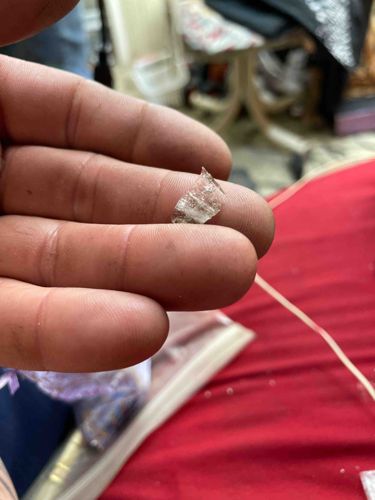
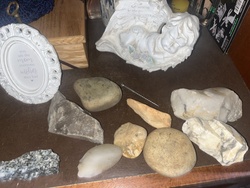
The item is a small, irregular fragment of a translucent material, potentially clear glass, plastic, or a natural mineral such as quartz. Based on its scale relative to the human finger, it measures approximately 0.5 to 1 centimeter in length. The material appears colorless with a high degree of transparency, though it features internal striations and surface textures that suggest it resulted from a fracture. The edges are sharp and jagged, exhibiting conchoidal fracturing typical of amorphous solids like glass or certain crystalline structures. There are no visible maker's marks, signatures, or decorative elements, as this appears to be a secondary byproduct or a piece of debris rather than a finished object. The condition is characterized as damaged or broken, with significant surface irregularities and lack of structural uniformity. It lacks any identifiable style or period, as its form is entirely accidental. Due to its size and state, it possesses no decorative or functional craftsmanship value in its current condition, appearing most likely to be a discarded shard from a larger vessel or component. The clarity is relatively high, and there is no visible patina, though minor surface dirt or oil from handling is present.
AI Appraisal Report
Upon examination of the provided image, I have analyzed a small, irregular fragment of translucent material, measuring approximately 0.5 to 1 centimeter. Visually, the object exhibits conchoidal fracturing and sharp, jagged edges, characteristics strongly indicative of broken silica-based glass or shattered quartz. The high transparency and lack of inclusions suggest it is likely modern clear glass, possibly a shard from a broken vessel or window pane, rather than a significant mineral specimen. As a raw fragment lacking provenance, identifiable craftsmanship, or gemological significance, it is classified as debris rather than a structured artifact.
From a market perspective, there is no commercial demand for singular, unidentifiable shards of this nature. While natural quartz crystals have mineralogical value based on clarity and termination, this piece lacks the natural crystal habit or size to warrant interest from collectors. Similarly, if this were glass, it holds no value without being part of a recognizable historic or artistic object. Simply put, the item functions as a secondary byproduct of breakage.
Authenticating the specific material composition (e.g., distinguishing between soda-lime glass, borosilicate, or natural quartz) would require physical tests such as a scratch test for hardness (Mohs scale) or refractive index testing. However, even if identified as natural quartz, the microscopic scale and fractured condition render the material negligible in value. Consequently, I must appraise this item as having no commercial resale value.