AI Appraisal Estimate

AI-generated estimates · not official valuations

From the user

What was submitted

Photo and notes provided by the user — not generated by AI

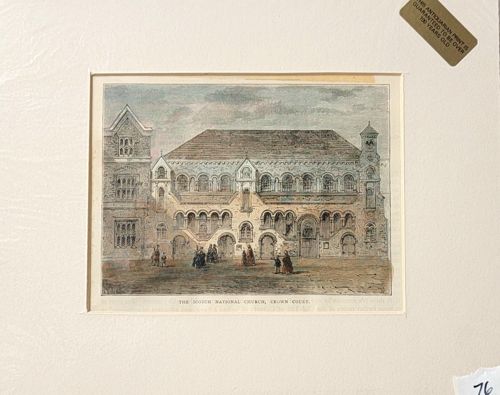
Submitted item photo
Submitted photo · June 13, 2026

User's notes

No additional notes provided.

AI analysis below

AI appraisal

AI analysis & estimate

AI-Generated · Verify before acting

Everything below is generated by AI for informational purposes only. AI can make mistakes — the AI may misidentify items or misattribute them (artist, maker, brand, designer, origin, era). This is not an official valuation and should not be used for insurance, sale, tax, estate, legal, or lending purposes — or any decision requiring a certified appraisal. It is not an authoritative claim about any person, brand, or rights holder — do not share or rely on it as a factual statement about a third party. Always consult qualified professionals before making financial decisions.

Read the full disclaimer

AI Identification

·Not independently authenticated·Verify before acting

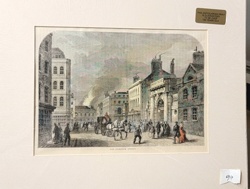
Antiquarian Hand-Colored Engraving of The Scotch National Church, Crown Court

Art & Antiquarian Prints

AI Estimated Value

·Not an official valuation·Verify before acting

$125.00 - $175.00

As of June 13, 2026

AI Item Analysis

·AI can make mistakes·Verify before acting
This is an original 19th-century antiquarian print featuring a detailed architectural illustration of 'The Scotch National Church, Crown Court.' The piece is an engraving, likely a wood or steel plate, finished with hand-applied watercolor washes in muted tones of blue, terracotta, and soft greens. The artwork depicts the historic Victorian-style church with figures dressed in period attire in the foreground, providing a sense of scale and historical context. The print is professionally mounted within a cream-colored, textured acid-free mat. A gold authenticity sticker in the upper right corner states 'This Antiquarian Print is Guaranteed to be over 100 years old,' which places its production no later than the early 1900s, though the architectural style and engraving technique suggest a mid-to-late 19th-century origin. The print appears to be in good vintage condition with minor foxing or light toning consistent with age, particularly along the bottom edge where the title is printed. The fine linework remains crisp, indicating high-quality craftsmanship from a reputable publisher of architectural or topographical prints. A small white inventory tag labeled '76' is visible on the bottom right of the matting.
AI Appraisal Report

·AI can make mistakes·Verify before acting
I have conducted a visual examination of the hand-colored engraving titled 'The Scotch National Church, Crown Court.' Based on the engraving technique and the characteristic Victorian architectural subject matter, this piece appears to be a mid-to-late 19th-century topographical print, likely originally published in a period periodical such as 'The Illustrated London News' or a similar architectural compendium. The hand-coloring is well-executed with muted watercolor washes that remain vibrant. The crispness of the linework suggests it was struck from a plate in good condition. I note minor foxing and toning along the lower margin, which is typical for paper of this age and does not significantly detract from the aesthetic appeal. The market for 19th-century topographical engravings of London landmarks is steady but saturated. Collectors typically look for specific personal or historical connections to the location. While the print is professionally matted and carries a guarantee of being over 100 years old, these items were mass-produced for the growing middle-class market of the 1800s, which limits their rarity and keeps the valuation within a moderate range. Higher values are usually reserved for larger-scale folio prints or those by globally renowned engravers. Note that this appraisal is based on image analysis alone. Full authentication would require an in-person examination to verify the paper's watermark and texture, as well as a microscopic inspection of the ink to confirm it is a genuine period strike rather than a later photolithographic reproduction. Determining if the colors are contemporary to the printing or added later ('modern coloring') would also require physical inspection of the pigment interaction with the paper fibers. No provenance documentation was provided, which would be necessary to increase the valuation beyond standard fair market rates.

Get your items appraised

Instant estimates of your treasures with AI-powered appraisals

Browse More Appraisals