AI Appraisal Estimate

AI-generated estimates · not official valuations

From the user

What was submitted

Photo and notes provided by the user — not generated by AI

Submitted item photo
Submitted photo · June 1, 2026

User's notes

No additional notes provided.

AI analysis below

AI appraisal

AI analysis & estimate

AI-Generated · Verify before acting

Everything below is generated by AI for informational purposes only. AI can make mistakes — the AI may misidentify items or misattribute them (artist, maker, brand, designer, origin, era). This is not an official valuation and should not be used for insurance, sale, tax, estate, legal, or lending purposes — or any decision requiring a certified appraisal. It is not an authoritative claim about any person, brand, or rights holder — do not share or rely on it as a factual statement about a third party. Always consult qualified professionals before making financial decisions.

Read the full disclaimer

AI Identification

·Not independently authenticated·Verify before acting

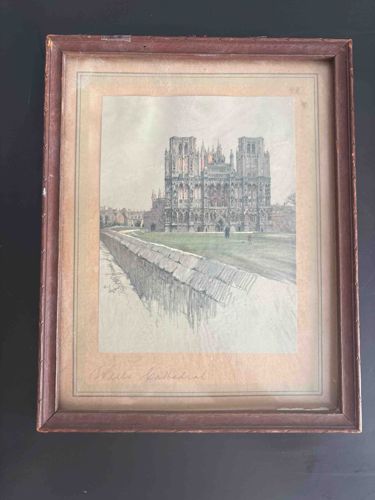
Antiquarian Wells Cathedral Framed Print

Antique Prints and Architectural Art

AI Estimated Value

·Not an official valuation·Verify before acting

$45.00 - $75.00

As of June 1, 2026

AI Item Analysis

·AI can make mistakes·Verify before acting
This is a vintage architectural print depicting the West Front of Wells Cathedral in Somerset, England. The artwork features a soft color palette with muted greens for the Cathedral Green and subtle stone hues for the Gothic architecture, characteristic of early to mid-20th-century lithographic or etching processes. The composition is viewed from a diagonal perspective behind a stone wall, adding depth to the scene. The print is set within a decorative paper mat that contains hand-drawn border lines and handwritten cursive text at the bottom reading 'Wells Cathedral'. The piece is housed in a simple, dark-stained wooden transition frame with mitered corners. Physically, the item shows significant age-related wear: the wooden frame exhibits numerous scuffs, paint transfer marks, and edge chipping, particularly along the top and left sides. The paper matting shows noticeable foxing, yellowing, and moisture staining, especially in the upper corners and along the bottom edge where the handwriting is located. There is a slight ripple to the paper, suggesting it has been exposed to humidity over time. The glass appears intact but may require internal cleaning. The style suggests a souvenir architectural study from the early 1900s, reflecting a traditionalist British aesthetic.
AI Appraisal Report

·AI can make mistakes·Verify before acting
I have examined the provided image of the framed print depicting the West Front of Wells Cathedral. Based on the visual evidence, the piece appears to be a mid-20th-century lithographic reproduction rather than a rare hand-colored etching or early engraving. While it captures a traditional British aesthetic popular in the 1930s-1950s, the current condition significantly hampers its marketability. The presence of advanced foxing, moisture staining on the matting, and visible rippling suggests long-term exposure to unfavorable humidity levels, which may indicate acid damage or potential mold spores beneath the glass. The frame shows heavy wear, including scuffs and paint loss, reducing its utility as a display piece without restoration. Market demand for mid-tier architectural prints of English cathedrals is currently soft, with buyers favoring either high-end 18th-century antiquarian engravings or pristine, modern decorative prints. Comparables for similar framed souvenirs in this condition typically realize low double-digit figures at regional estate auctions. The primary value lies in its decorative appeal for a specific 'shabby chic' or 'English cottage' interior design niche. Limitations: My assessment is based solely on digital images. Without an in-person examination, I cannot inspect the paper's watermark, verify if the backing is acid-free, or determine if the 'handwritten' text is ink-signed or printed. A physical inspection would be required to rule out mechanical printing dot patterns (halftone) versus fine-line lithography. Full authentication would require removing the print from the frame to examine the verso and the paper structure under magnification. No provenance documentation was provided to elevate its historical significance.

Get your items appraised

Instant estimates of your treasures with AI-powered appraisals

Browse More Appraisals