These notes were written by the person who submitted this item. Appraiser.AI has not verified them, and the AI's identification and estimate may rely on them.
AI Estimated Value
Not an official valuation
$75 - $150
AI estimate as of August 31, 2025 · verify with a professional before acting
AI-Generated · Verify before acting
Everything on this page is generated by AI for informational purposes only. AI can make mistakes — the AI may misidentify items or misattribute them (artist, maker, brand, designer, origin, era). This is not an official valuation and should not be used for insurance, sale, tax, estate, legal, or lending purposes — or any decision requiring a certified appraisal. It is not an authoritative claim about any person, brand, or rights holder — do not share or rely on it as a factual statement about a third party. Always consult qualified professionals before making financial decisions.
This analysis also relies on unverified notes provided by the user, which may be incomplete or inaccurate and could affect the result.
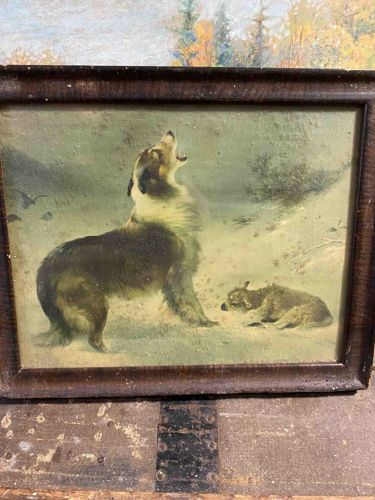
This item is an antique or vintage framed print depicting a scene with two dogs in a snowy or desolate landscape. The central figure is a large, shaggy-haired dog, possibly a Collie or similar breed, standing on its hind legs and howling upwards, conveying a sense of lament or calling. Its fur shows shades of brown, black, and cream. To the right and slightly in front of the howling dog, another smaller, darker-furred animal, likely a puppy or a young dog, is lying down in a curled position, appearing to be deceased or asleep. The background features a muted green-grey sky and ground, suggesting a cold, barren environment, with hints of sparse vegetation or earth showing through the snow. Several dark bird silhouettes are visible in the upper-left corner of the print, adding to the somber mood. The print exhibits considerable age and wear, including visible fading and discoloration, and possibly foxing or other forms of deterioration consistent with paper-based media of its era. The frame is simple, made of dark wood with a slightly rounded profile, and shows some surface scuffs, dust, and what appears to be scattered white residue or paint speckles, indicating its age and handling. The craftsmanship of the print itself, while difficult to ascertain definitively from the image, suggests a lithographic or chromolithographic process common in the late 19th or early 20th century. The overall condition of both the print and the frame points to an object that has been displayed for many years, acquiring a rich patina.
AI Appraisal Report
Based on my visual examination of the provided image of 'The Sentinel' (or similar motif) print, its condition is consistent with an antique or vintage paper-based artwork that has seen significant display. The print exhibits considerable fading and discoloration, common in chromolithographs or lithographs from the late 19th to early 20th century. While difficult to ascertain definitively from an image, there may be foxing or other forms of deterioration. The dark wooden frame, while original to the piece, shows expected wear, including scuffs and what appears to be minor residue, indicating age and history without significant damage. Authenticity as a period print appears high based on the visual cues of the printing process and aging. However, without in-person inspection, I cannot confirm if it's a first-run print, a later impression, or a copy.
The market for antique prints of this sentimental or narrative genre (animalia, especially dogs) is stable but not exceptionally strong unless tied to a highly renowned artist or specific historical significance. This print's motif, while evocative, is not unique enough to command premium prices. Comparables for similar framed, somewhat faded period prints of this size and subject matter typically fall into the antique shop or online marketplace range, rather than fine art gallery prices. Demand is moderate, usually from collectors of Americana, dog art, or period decor. Rarity is low; many such prints were produced. Factors impacting value include the discoloration and the commonality of the image type.
Limitations: A full authenticity verification would require physical examination to assess paper quality, printing technique details (e.g., dot pattern for chromolithography), and the presence of any artist's or publisher's marks obscured by the frame or too small to discern from the image. Provenance documentation (e.g., original sales receipts, exhibition history) would greatly enhance value verification. Scientific testing of the paper and inks could confirm age and origin definitively. Without these, the appraisal is based purely on visual assessment and market trends for similar items.