AI Appraisal Estimate

AI-generated estimates · not official valuations

From the user

What was submitted

Photo and notes provided by the user — not generated by AI

Submitted item photo
Submitted photo · June 13, 2026

User's notes

No additional notes provided.

AI analysis below

AI appraisal

AI analysis & estimate

AI-Generated · Verify before acting

Everything below is generated by AI for informational purposes only. AI can make mistakes — the AI may misidentify items or misattribute them (artist, maker, brand, designer, origin, era). This is not an official valuation and should not be used for insurance, sale, tax, estate, legal, or lending purposes — or any decision requiring a certified appraisal. It is not an authoritative claim about any person, brand, or rights holder — do not share or rely on it as a factual statement about a third party. Always consult qualified professionals before making financial decisions.

Read the full disclaimer

AI Identification

·Not independently authenticated·Verify before acting

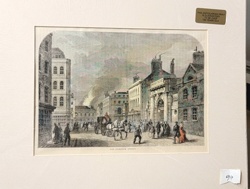
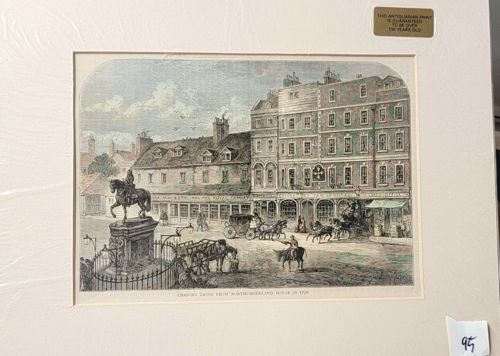
Charing Cross from Northumberland House in 1750 Antiquarian Print

Art - Antiquarian Prints

AI Estimated Value

·Not an official valuation·Verify before acting

$45.00 - $75.00

As of June 13, 2026

AI Item Analysis

·AI can make mistakes·Verify before acting
This is a matted antiquarian print depicting a historical street scene of Charing Cross, London. The print is hand-colored or color-lithographed, showing a bustling urban center with horse-drawn carriages, a donkey, and pedestrians positioned around the prominent statue of King Charles I. The architecture featured includes Northumberland House and adjacent period buildings with detailed facades and signage. The print is housed in a textured, off-white decorative matting. A gold sticker in the upper right corner of the mat states 'THIS ANTIQUARIAN PRINT IS GUARANTEED TO BE OVER 100 YEARS OLD,' suggesting it was produced in the late 19th or very early 20th century, likely as a retrospective historical illustration. The caption at the bottom reads 'CHARING CROSS FROM NORTHUMBERLAND HOUSE IN 1750'. The artwork shows signs of light toning consistent with age, though the colors remain largely intact. The matting appears modern or mid-century based on the texture and the typography of the guarantee sticker. A small handwritten tag '95' is visible in the bottom right corner, likely representing a lot number or price tag from an estate sale or gallery inventory. The overall craftsmanship reflects Victorian-era interest in historical topography and architectural documentation.
AI Appraisal Report

·AI can make mistakes·Verify before acting
I have examined the digital image of the antiquarian print titled 'Charing Cross from Northumberland House in 1750.' Based on the typography, the 'Guaranteed over 100 years old' sticker, and the specific illustrative style, I have identified this as a late Victorian wood engraving or lithograph, likely harvested from a historical publication such as 'Old and New London' (c. 1870-1880). While the scene depicts 1750, the print itself was produced approximately 100–130 years later. The condition appears fair to good. There is visible toning (browning) across the paper, which is common for the wood-pulp-based papers of the late 19th century. The hand-coloring appears to be a later addition or a standard commercial application of the era, which adds decorative appeal but not significant rarity. The matting is a mid-20th-century addition and is not of archival quality, meaning it may be contributing to the acidity affecting the paper edges. Market demand for Victorian architectural prints of London remains steady for decorative purposes but has declined significantly from the highs of the 1990s. Comparables for individual plates from this era typically sell in the $30-$60 range at retail galleries. The '95' notation likely represents a past retail asking price. Authenticity Limitations: This appraisal is based solely on digital imagery. To provide a definitive valuation, I would need to examine the print outside of the matting to inspect the paper's watermark and edge-wear. A physical inspection would determine if the colors are period-correct watercolors or modern inks. Verification of the specific publication it was removed from would also solidify its historical context.

Get your items appraised

Instant estimates of your treasures with AI-powered appraisals

Browse More Appraisals