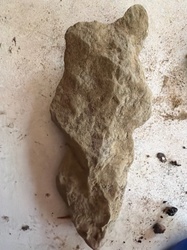
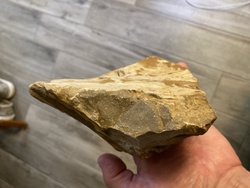
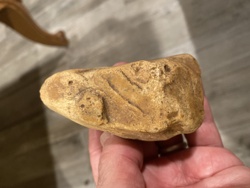
Antique Pre-historic Old rock with several different layouts and images
These notes were written by the person who submitted this item. Appraiser.AI has not verified them, and the AI's identification and estimate may rely on them.
AI Estimated Value
Not an official valuation
$50 - $200
AI estimate as of October 4, 2025 · verify with a professional before acting
AI-Generated · Verify before acting
Everything on this page is generated by AI for informational purposes only. AI can make mistakes — the AI may misidentify items or misattribute them (artist, maker, brand, designer, origin, era). This is not an official valuation and should not be used for insurance, sale, tax, estate, legal, or lending purposes — or any decision requiring a certified appraisal. It is not an authoritative claim about any person, brand, or rights holder — do not share or rely on it as a factual statement about a third party. Always consult qualified professionals before making financial decisions.
This analysis also relies on unverified notes provided by the user, which may be incomplete or inaccurate and could affect the result.
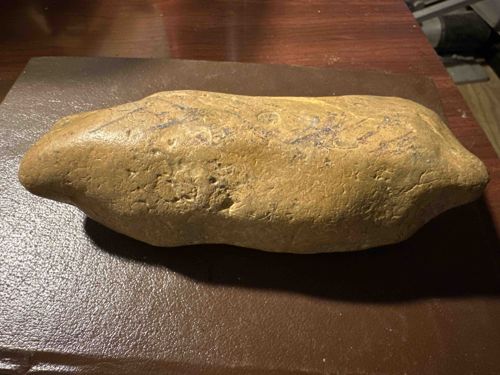
This item is a weathered, elongated stone, likely a river stone or a similar type of smooth, naturally eroded rock. Its primary coloration is a warm, earthy tan or light brown, with some darker areas suggesting mineral inclusions or accumulated dirt/patina. The stone exhibits a generally ovate, somewhat flattened shape, approximately the size of a large loaf of bread, though precise dimensions are not discernible from the image. The surface is uneven, characterized by small pits, indentations, and a subtly textured appearance, indicative of natural weathering processes over a significant period. There are visible dark, linear markings incised or drawn onto the surface of the stone, primarily towards the upper central portion. These markings appear abstract and irregular, possibly suggesting symbols, figures, or random doodles. Their dark color contrasts with the lighter stone, making them somewhat distinct. It is challenging to determine if these markings are ancient petroglyphs, later attempts at carving, or more recent graffiti. The texture of the lines suggests they are either shallowly incised or drawn with a resistant material. The stone's overall condition appears stable; there are no obvious signs of recent breakage or significant damage, only the natural wear and tear expected of a stone exposed to elements. Its smooth, rounded edges suggest a history of tumbling or water erosion. Given the context of 'Pre-historic Old rock with several different layouts and images,' these markings are hypothesized to be of archaeological or anthropological interest, though further scientific analysis would be required to confirm their age and origin. The craftsmanship of the markings cannot be assessed without clarification on their nature.
AI Appraisal Report
Based on my remote visual examination of the provided image, this weathered stone with incised markings presents as an intriguing geological specimen with potential archaeological interest. The stone itself appears to be a naturally eroded river stone or similar, exhibiting natural wear and coloration consistent with prolonged exposure to the elements. Its condition is sound, showing no recent damage other than natural patination and surface irregularities. The critical element affecting value are the incised markings. These markings are dark and appear abstract, contrasting with the stone's surface. Without physical examination, it is impossible to definitively authenticate these as ancient petroglyphs versus more recent carvings or even natural phenomena. The owner's description of it being an "Antique Pre-historic Old rock with several different layouts and images" suggests a belief in its antiquity, but this cannot be confirmed remotely.
Market conditions for unauthenticated archaeological artifacts are highly speculative. If these markings were scientifically verified as authentic prehistoric petroglyphs, the value would skyrocket into the tens of thousands or more, depending on age, cultural significance, and rarity. However, as it stands, it is essentially a decorative natural stone with ambiguous markings. Comparables would be other natural stones with interesting features or art pieces where the 'art' is unauthenticated. Demand for unauthenticated items is low, and rarity is unknown until proven.
Factors significantly impacting value are authenticity of the markings. To verify authenticity and maximize value, in-person examination by a professional archaeologist or geologist is crucial. This would involve scrutinizing the patina within the incisions, microscopic analysis, and potentially dating techniques like thermoluminescence or radiocarbon dating if organic material is present. Without such testing and clear provenance documentation, its current value is primarily as an interesting decorative stone, hence the conservative appraisal range.