These notes were written by the person who submitted this item. Appraiser.AI has not verified them, and the AI's identification and estimate may rely on them.
AI Estimated Value
Not an official valuation
$0.50 - $1.50
AI estimate as of November 10, 2025 · verify with a professional before acting
AI-Generated · Verify before acting
Everything on this page is generated by AI for informational purposes only. AI can make mistakes — the AI may misidentify items or misattribute them (artist, maker, brand, designer, origin, era). This is not an official valuation and should not be used for insurance, sale, tax, estate, legal, or lending purposes — or any decision requiring a certified appraisal. It is not an authoritative claim about any person, brand, or rights holder — do not share or rely on it as a factual statement about a third party. Always consult qualified professionals before making financial decisions.
This analysis also relies on unverified notes provided by the user, which may be incomplete or inaccurate and could affect the result.
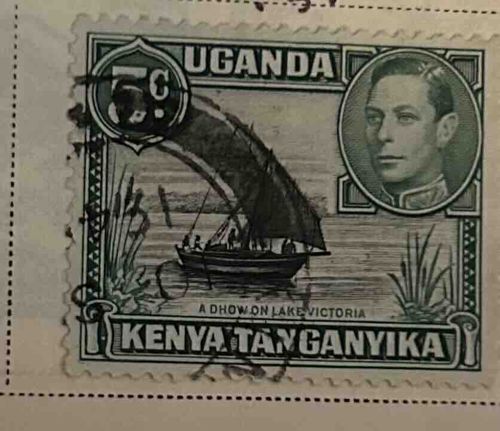
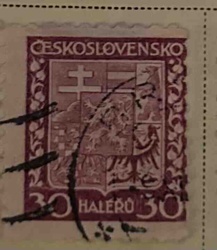
This item is an adhesive postage stamp issued for the British East African territories of Kenya, Uganda, and Tanganyika. The stamp features a central vignette depicting a 'dhow on Lake Victoria', a traditional sailing vessel, prominently positioned on the water with reeds along the banks. In the upper right quadrant, there is a circular portrait of King George VI, rendered in a classical profile view, indicating that this stamp was issued during his reign (1936-1952). The denomination '5 C' (5 Cents) is visible in the upper left corner within an ornate shield-like emblem. The names 'UGANDA' and 'KENYA TANGANYIKA' are clearly printed at the top and bottom of the stamp, respectively, in block letters. The overall color scheme is predominantly green and white, characteristic of many colonial-era stamps. The stamp exhibits a perforated edge, which is consistent with postal stamps designed for tearing from a sheet. Visible condition issues include a circular ink cancelation mark over the '5 C' denomination and extending into the dhow image, indicating it has been used for postage. The image resolution suggests some minor discoloration or aging of the paper, but no significant tears or creases are immediately apparent. The intricate linework and detailed depiction of the dhow and King George VI's portrait suggest a high quality of engraving and printing craftsmanship typical of British colonial issues. Without a precise date, it can be broadly assigned to the mid-20th century, specifically the period of King George VI's reign.
AI Appraisal Report
Based on my examination of the provided image, this Kenya, Uganda, Tanganyika 5 Cents stamp featuring King George VI and a Dhow on Lake Victoria appears to be an authentic, used example. The design, including the dhow vignette, King George VI's portrait, and the 'KENYA TANGANYIKA UGANDA' inscription, is consistent with known issues from this British East African series during King George VI's reign (1938-1952). The perforations and printing quality also align with typical colonial-era issues.
The stamp's condition is fair for a used item. The circular ink cancellation mark, while obscuring part of the '5 C' denomination and the dhow image, confirms its postal use. I note minor discoloration consistent with aging. However, without a physical inspection, it is impossible to definitively rule out minor thinning, hidden creases, or repairs that might not be visible in the image. The authenticity of the cancellation mark itself would also require closer examination.
Market conditions for common, used colonial stamps like this are generally modest. This specific 5 Cents denomination is not considered rare. Comparables show similar used examples typically trading for less than a few dollars. Demand is steady but not high unless it's an uncancelled example, a rare printing variety, or part of a high-quality collection.
The primary factor impacting value here is its used condition and common status. While a beautiful design, its widespread availability keeps its value relatively low. For a definitive assessment of authenticity and condition, a physical examination under magnification would be crucial to detect any repairs, alterations, or subtle printing varieties. Provenance documentation, though unlikely for such a common stamp, would also support authenticity.