AI Appraisal Estimate

AI-generated estimates · not official valuations

From the user

What was submitted

Photo and notes provided by the user — not generated by AI

Submitted item photo
Submitted photo · June 8, 2026

User's notes

No additional notes provided.

AI analysis below

AI appraisal

AI analysis & estimate

AI-Generated · Verify before acting

Everything below is generated by AI for informational purposes only. AI can make mistakes — the AI may misidentify items or misattribute them (artist, maker, brand, designer, origin, era). This is not an official valuation and should not be used for insurance, sale, tax, estate, legal, or lending purposes — or any decision requiring a certified appraisal. It is not an authoritative claim about any person, brand, or rights holder — do not share or rely on it as a factual statement about a third party. Always consult qualified professionals before making financial decisions.

Read the full disclaimer

AI Identification

·Not independently authenticated·Verify before acting

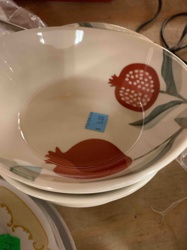
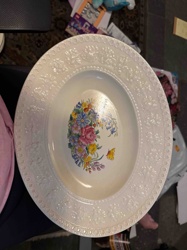
White Ceramic Bowl with Green Floral Design and Gilded Rim

Dinnerware / Serving Bowl

AI Estimated Value

·Not an official valuation·Verify before acting

$25-50

As of June 8, 2026

AI Item Analysis

·AI can make mistakes·Verify before acting
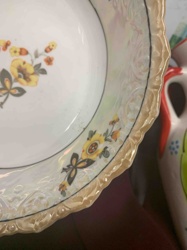
This item is a white ceramic or porcelain serving bowl, likely a pasta or soup bowl, featuring an ornate floral and foliate design in shades of green. The main body of the bowl is a clean white, providing a striking contrast to the decoration. The rim of the bowl features a prominent band of what appears to be a muted olive or sage green, approximately 1 to 1.5 inches wide. Within this green band, there's a subtle golden or light brown linear design, possibly a geometric or repeating scroll pattern, adding a touch of elegance. The interior of the bowl is adorned with large, stylized floral motifs, predominantly in various shades of green, from a lighter lime green to a deeper emerald. These flowers appear to be peonies or similar full-bodied blossoms, accompanied by ample leaves and smaller foliage. The brushstrokes or application of the design suggest either hand-painted detailing or a high-quality decal with a hand-painted finish simulation. There are no readily apparent chips, cracks, or significant wear visible from the top-down view, indicating good overall condition, though a small orange price sticker is affixed to the inside base of the bowl. The quality of the ceramic appears to be good, with a smooth, glossy finish. While no specific maker's marks or signatures are visible in the provided image, the style suggests an East Asian influence, possibly Chinese or Japanese, and could date from the mid-20th century to contemporary production, given the timeless nature of such floral designs.
AI Appraisal Report

·AI can make mistakes·Verify before acting
Upon examining this White Ceramic Bowl with Green Floral Design and Gilded Rim, I find it to be in good overall condition. There are no visible chips, cracks, or significant wear from the top-down view. The surface appears smooth and glossy, suggesting good quality ceramic or porcelain. The floral and foliate design, executed in various shades of green, combined with the gilded rim, points to a likely East Asian aesthetic, possibly Chinese or Japanese. The presence of an orange price sticker on the interior base indicates it's been handled in a retail setting. Market conditions for dinnerware and serving bowls of this style are generally stable. While not overtly rare, the detailed floral motif and gilded accent contribute to its aesthetic appeal. Comparables for mass-produced, decorative serving bowls of unknown provenance typically fall within the lower-to-mid range of collectible dinnerware. Demand for such items is moderate, often driven by interior decorators or individuals seeking accent pieces for home decor. Factors significantly impacting value include the lack of a visible maker's mark, which prevents attribution to a specific manufacturer or artisan. Without provenance documentation, its history and origin remain speculative. While the design quality is good, it's impossible to definitively determine from images alone whether the decoration is hand-painted or a high-quality decal. True hand-painting would increase value. Limitations in authenticity verification are significant. A physical, in-person examination would be crucial to assess the true quality of the ceramic, the application technique of the design (hand-painted vs. decal), and to search for any faint or obscured maker's marks not visible in the image. Scientific testing (e.g., to confirm material composition) or detailed provenance documentation (e.g., original purchase receipts, historical ownership records) would be needed for full authentication and to ascertain its precise age and whether it's a newer reproduction or an older piece with collectible value. The current assessment is based purely on visual appearance.

Get your items appraised

Instant estimates of your treasures with AI-powered appraisals

Browse More Appraisals