These notes were written by the person who submitted this item. Appraiser.AI has not verified them, and the AI's identification and estimate may rely on them.
AI Estimated Value
Not an official valuation
$25-45
AI estimate as of July 11, 2025 · verify with a professional before acting
AI-Generated · Verify before acting
Everything on this page is generated by AI for informational purposes only. AI can make mistakes — the AI may misidentify items or misattribute them (artist, maker, brand, designer, origin, era). This is not an official valuation and should not be used for insurance, sale, tax, estate, legal, or lending purposes — or any decision requiring a certified appraisal. It is not an authoritative claim about any person, brand, or rights holder — do not share or rely on it as a factual statement about a third party. Always consult qualified professionals before making financial decisions.
This analysis also relies on unverified notes provided by the user, which may be incomplete or inaccurate and could affect the result.
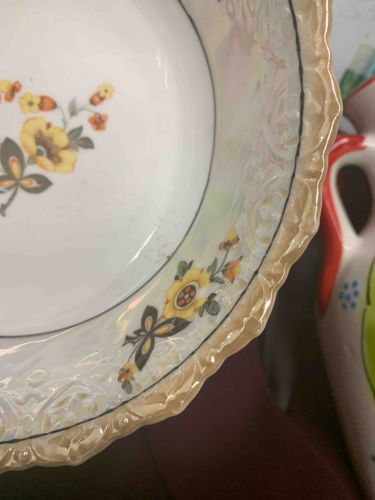
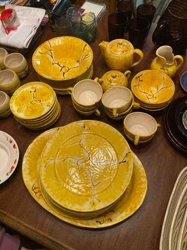
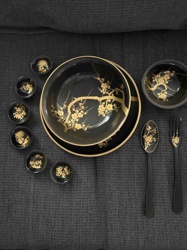
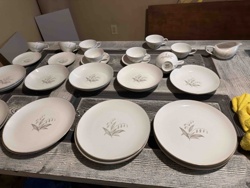
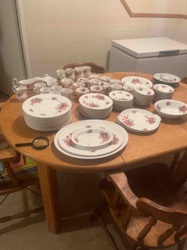
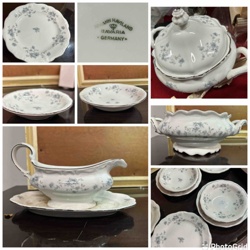
This item is a decorative porcelain bowl, likely a serving bowl or salad bowl, characterized by its elegant design and floral motif. The bowl features a gently scalloped rim, which is further accentuated by a raised, embossed pattern of swirling scrolls or foliage on the outer edge, giving it a textural and ornate quality. This embossed rim appears to be glazed in a lustrous, iridescent finish, possibly a mother-of-pearl or opalescent glaze, which reflects light with subtle color shifts, predominantly in tones of cream, light gold, and hints of pink or green. A thin, dark line, possibly hand-painted, outlines the inner edge of this scalloped and embossed border, providing definition. The main body of the bowl's interior is a pristine white, serving as a bright canvas for the decorative elements. Applied to the interior surface are vibrant floral decals or hand-painted designs. The dominant flowers are stylized in shades of yellow and orange, with accompanying leaves and stems in a muted brownish-green or grey. These floral clusters are symmetrically placed on opposite sides of the bowl's interior. One distinct cluster shows a larger, more intricate yellow flower with multiple petals and a central dark detail, accompanied by smaller buds. The overall condition appears good, with no immediately visible chips, cracks, or significant wear. The shiny glaze suggests good preservation. Given the 'Bavaria' stamp mentioned, this bowl originates from Bavaria, Germany, a region renowned for its high-quality porcelain production, indicating good craftsmanship and material quality. The style suggests a mid-20th century production, possibly 1950s-1970s, characteristic of a more ornate, yet functional, dinnerware aesthetic.
AI Appraisal Report
Upon examination of the provided images and description, this porcelain serving bowl is identified as a product of the Bavaria region in Germany, a historic center for fine porcelain manufacturing. The piece features a distinctive design with a scalloped, embossed rim finished with an iridescent, mother-of-pearl-like glaze. The interior is decorated with vibrant floral transfers, likely decals, which was a common and cost-effective decoration method for mid-20th-century porcelain. The style, combining ornate embossed details with colorful floral motifs, is characteristic of tableware produced between the 1950s and 1970s. Based on visual inspection, the bowl appears to be in very good condition, with no visible chips, cracks, or crazing, which is crucial for its value. The 'Bavaria' backstamp confirms its origin, but without a specific maker's mark (e.g., Rosenthal, Hutschenreuther), it is considered a more generic, though well-crafted, piece from the region. The market for this type of decorative porcelain is generally modest, driven by collectors of vintage dinnerware and those seeking decorative items. While aesthetically pleasing, similar bowls from various Bavarian factories are quite common. Its value is primarily as a decorative or functional serving piece rather than a rare collectible. For a definitive valuation and authentication, an in-person examination would be necessary to identify any hidden restorations, confirm the backstamp details, and verify whether the floral elements are decals or hand-painted, the former being less valuable.