AI estimate as of August 31, 2025 · verify with a professional before acting
AI-Generated · Verify before acting
Everything on this page is generated by AI for informational purposes only. AI can make mistakes — the AI may misidentify items or misattribute them (artist, maker, brand, designer, origin, era). This is not an official valuation and should not be used for insurance, sale, tax, estate, legal, or lending purposes — or any decision requiring a certified appraisal. It is not an authoritative claim about any person, brand, or rights holder — do not share or rely on it as a factual statement about a third party. Always consult qualified professionals before making financial decisions.
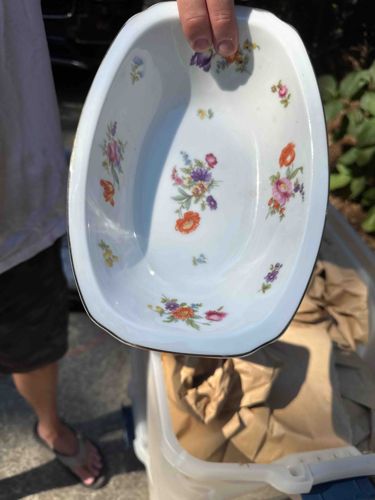
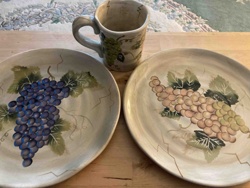
This item is an oblong, possibly oval or rectangular with rounded corners, porcelain serving bowl or dish. Its primary color is white, providing a clean and elegant background for the vibrant floral decorations. The rim of the bowl appears to be subtly scalloped or wavy, adding a decorative touch, and is edged with a thin, dark line, likely gold or black, which suggests a refinement in its design. The interior of the bowl is adorned with multiple clusters of scattered floral motifs. These floral designs feature a variety of colors, including shades of orange, pink, purple, yellow, and green, indicative of a polychrome enamel decoration. The flowers appear to be in various arrangements, with some individual blossoms and others in small bouquets. The size is difficult to ascertain precisely from the image, but it appears to be a medium-sized serving dish suitable for vegetables or side dishes. No apparent cracks, chips, or significant wear are visible from this vantage point, suggesting it is in good to very good condition, though further inspection would be needed to confirm. The style of the floral decoration and the scalloped edge suggest a traditional or antique aesthetic, possibly dating from the late 19th to mid-20th century, though without a discernible maker's mark, a precise age is hard to determine. The craftsmanship appears to be of good quality, typical of mass-produced yet decorative porcelain dinnerware.
AI Appraisal Report
Based on my visual examination of this Floral Decorated Porcelain Serving Bowl, it presents as an oblong serving dish, likely porcelain, with an appealing white background adorned with polychrome floral motifs. The scalloped, gold- or black-edged rim adds a touch of refinement. The floral designs, featuring orange, pink, purple, yellow, and green, are vibrant and scattered artistically within the bowl. Visual inspection suggests good to very good condition, with no obvious chips, cracks, or significant wear. However, without physical handling, confirming the absence of hairline cracks, crazing, or subtle repairs is impossible.
From the image alone, authenticity cannot be definitively verified. While the style points to a traditional aesthetic, potentially late 19th to mid-20th century, a precise age without a discernible maker's mark or provenance is speculative. The craftsmanship appears competent for mass-produced decorative ware, typical of that era. Comparisons with similar floral decorated serving dishes from known manufacturers like Syracuse China or Limoges, which often fetch between $50-$150 depending on rarity and condition, suggest a comparable market value.
Demand for this style of vintage decorative serveware is moderate, particularly for standalone pieces without a full set. Rarity is low, as production of such items was extensive. Factors impacting value include its good apparent condition and decorative appeal. However, the lack of a prominent maker's mark, unknown origin, and the commonality of similar items limit its upper value.
For full authentication and a more precise appraisal, I would require in-person examination to assess the porcelain's quality, search for hidden maker's marks or impressed numbers, and feel for any surface inconsistencies. Provenance documentation, if available, would also be highly beneficial. Scientific testing, such as X-ray fluorescence for glazes, is generally not cost-effective or necessary for items of this perceived value unless specific concerns about fakes arise.