AI estimate as of September 16, 2025 · verify with a professional before acting
AI-Generated · Verify before acting
Everything on this page is generated by AI for informational purposes only. AI can make mistakes — the AI may misidentify items or misattribute them (artist, maker, brand, designer, origin, era). This is not an official valuation and should not be used for insurance, sale, tax, estate, legal, or lending purposes — or any decision requiring a certified appraisal. It is not an authoritative claim about any person, brand, or rights holder — do not share or rely on it as a factual statement about a third party. Always consult qualified professionals before making financial decisions.
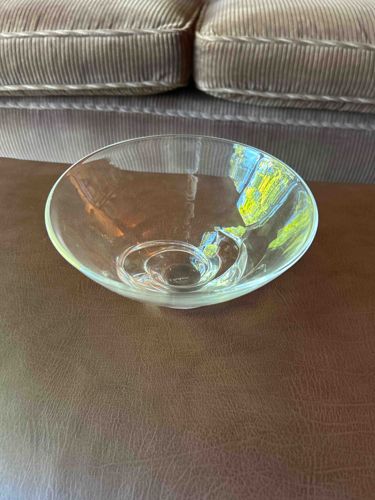
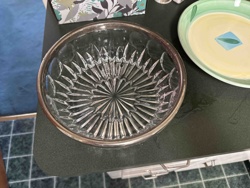
This is a clear glass serving bowl, likely crafted from soda-lime glass, exhibiting a smooth, transparent finish throughout. The bowl features a broad, shallow, circular form with gently sloped sides leading to a wide rim. A distinguishing characteristic of this piece is its integrated pedestal base, which is not a separate component but rather formed from the same continuous piece of glass as the bowl itself. This pedestal rises from the center of the bowl's bottom, creating a concentric, raised ring on the interior and a stable foot on the exterior. The craftsmanship appears to be machine-made or mass-produced, indicated by its uniform thickness and lack of discernible hand-blown pontil marks or imperfections typically associated with artisan glass. The edges of the rim seem to be fire-polished, contributing to a smooth and safe finish. The visible condition suggests minimal wear; no chips, cracks, or significant scratches are apparent from the provided image. The glass retains its clarity, with good light transmission, though some reflections from the surrounding environment are visible on its surface. There are no visible maker's marks, signatures, or stamps evident in the image. Although the exact age is difficult to pinpoint without further information, its design suggests a modern or contemporary style, likely from the late 20th century or early 21st century. The bowl's design is functional and versatile, suitable for serving salads, fruits, or decorative displays. The overall quality appears good for a utilitarian glass item, with a focus on clean lines and practical design.
AI Appraisal Report
I have examined the image of this clear glass serving bowl with an integrated pedestal base. Based on the visual evidence, the condition appears excellent, with no visible chips, cracks, or significant scratches. The clarity of the glass is well-maintained, suggesting minimal use and proper care. Authenticity, in the sense of verifying its material and manufacturing method, is consistent with my visual assessment of a machine-made, utilitarian soda-lime glass item. The lack of pontil marks and uniform thickness points to mass production.
Market conditions for such items are generally modest. This type of clear glass serving bowl is widely available from various manufacturers, both new and in the secondary market. Comparable items can be found in home goods stores, online retailers, and thrift stores, typically ranging from $10 to $40. While the integrated pedestal design is aesthetically pleasing and functional, it doesn't represent a unique or rare attribute that would significantly elevate its value. Demand for generic, mass-produced clear glass serving ware is steady but not high in the collectible market; it's primarily driven by utilitarian needs.
Factors impacting value include its good condition and versatile design. However, the lack of a known manufacturer, designer, or any distinguishing features (such as unique coloration, etching, or historical significance) limits its appeal beyond a functional kitchen or dining item. Without any maker's marks, provenance documentation, or artistic attribution, it remains a standard piece of glassware. My valuation is based on its typical resale value in the current secondary market for similar functional glass serving pieces.
It is important to note that my assessment of authenticity is based solely on visual cues from the image. A physical examination would allow me to accurately determine the glass type (e.g., lead crystal vs. soda-lime glass, which impacts value), confirm manufacturing methods through tactile inspection, and definitively rule out any subtle damage not apparent in photographs. In-person examination could also reveal tiny maker's marks often missed in images, although unlikely for this style. Chemical analysis could confirm glass composition if necessary for a more detailed appraisal, but this is overkill for an item of this type and expected value.