AI estimate as of September 10, 2025 · verify with a professional before acting
AI-Generated · Verify before acting
Everything on this page is generated by AI for informational purposes only. AI can make mistakes — the AI may misidentify items or misattribute them (artist, maker, brand, designer, origin, era). This is not an official valuation and should not be used for insurance, sale, tax, estate, legal, or lending purposes — or any decision requiring a certified appraisal. It is not an authoritative claim about any person, brand, or rights holder — do not share or rely on it as a factual statement about a third party. Always consult qualified professionals before making financial decisions.
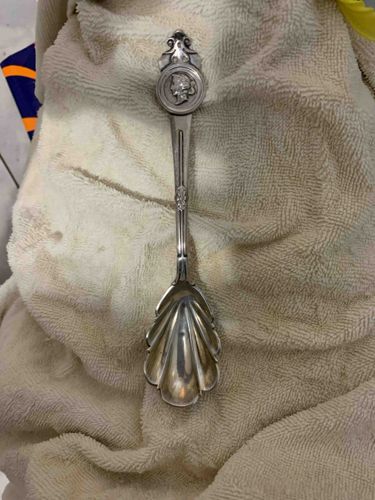
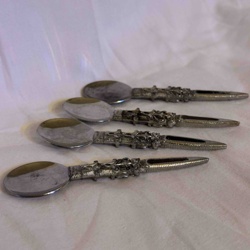
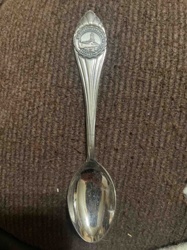
This is an ornate silver-plated spoon, likely a souvenir spoon, characterized by its intricate design and embossed details. The spoon features a bowl shaped like a fluted shell, giving it a distinctive and decorative appearance. The handle is slender and widens at the top, culminating in an elegant finial with scrollwork and an embossed circular medallion. Within this medallion, a profile of a figure, possibly a historical personage or a mythological character, is clearly depicted. Below the medallion, along the upper part of the handle, there is further decorative embossing, possibly floral or scrolled motifs that complement the overall aesthetic. The material appears to be silver-plated, judging by the reflective luster and absence of obvious hallmarks that would indicate sterling silver. The overall color is a bright, polished silver tone, suggesting it has been recently cleaned or is well-maintained. There are no immediately visible signs of heavy wear, significant damage, or extensive patina, although some minor surface scratches consistent with age and handling might be present upon closer inspection. The craftsmanship appears to be of good quality, with clear details in the embossed elements and a well-formed spoon bowl. Based on the style and decorative elements, including the ornate finial and embossed figure, this spoon likely dates from the late 19th or early 20th century, a common period for the production of souvenir spoons. Its unique design and specific embossed figure would be key to identifying its origin or purpose as a souvenir.
AI Appraisal Report
I have visually examined the provided image of this ornate silver-plated souvenir spoon. The condition appears to be very good, with a bright, polished luster and no immediate signs of heavy wear, dents, or significant plate loss. The embossed details, including the fluted shell bowl, scrollwork finial, and the circular medallion with the figure's profile, are crisp and well-defined, suggesting good original craftsmanship and careful handling over time. The lack of obvious damage or heavy tarnish enhances its visual appeal.
Regarding authenticity, based solely on the image, the spoon appears to be a genuine antique souvenir spoon from the late 19th or early 20th century, consistent with the style and production methods of that era. Its intricate design and embossed figural motif are typical of collectible souvenir flatware from that period. The absence of hallmarks, while limiting, is not unusual for silver-plated items of this type.
In terms of market conditions, souvenir spoons are a relatively niche collectible. While interest exists, the broader market for silver-plated items, as opposed to sterling silver, tends to be less robust. Comparable items frequently appear on online auction sites and at antique shows. The demand for common designs is moderate, but unique or historically significant figures can increase desirability. This spoon's value is primarily driven by its decorative appeal and collectible nature rather than intrinsic material value.
The main factors impacting its value are its excellent preserved condition, the quality of craftsmanship, and the distinctiveness of the embossed figure, which could indicate a specific location or event, increasing its appeal to certain collectors. Rarity is difficult to assess without knowing the specific figure's identity and production numbers; however, most silver-plated souvenir spoons are not exceedingly rare.
Limitations exist in full authentication from images alone. I cannot definitively verify the authenticity of the material (e.g., confirm it is indeed silver-plated and not a base metal), nor can I detect micro-scratches, pin-point plate wear, or other subtle condition issues. An in-person examination would allow for closer inspection of the plating, assessment of weight, and detection of any subtle repairs or alterations. Provenance documentation, such as original receipts or family history, would significantly enhance its historical authenticity and potential value. Chemical testing could confirm plating composition, though this is rarely done for items of this value range.