AI estimate as of October 8, 2025 · verify with a professional before acting
AI-Generated · Verify before acting
Everything on this page is generated by AI for informational purposes only. AI can make mistakes — the AI may misidentify items or misattribute them (artist, maker, brand, designer, origin, era). This is not an official valuation and should not be used for insurance, sale, tax, estate, legal, or lending purposes — or any decision requiring a certified appraisal. It is not an authoritative claim about any person, brand, or rights holder — do not share or rely on it as a factual statement about a third party. Always consult qualified professionals before making financial decisions.
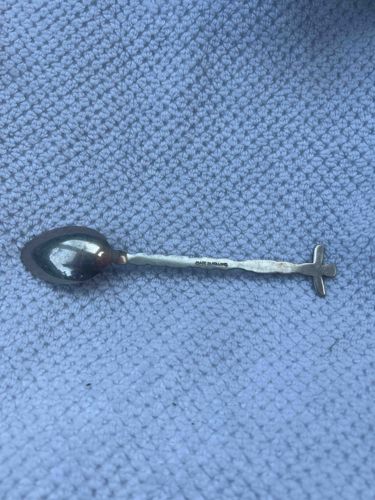
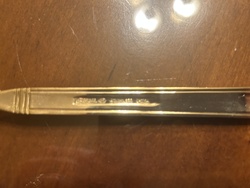
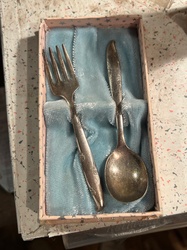
This item is an Apostle spoon, crafted from sterling silver, as indicated by the 'MADE IN ENGLAND' and 'STERLING' markings visible on the handle. The spoon features a small, somewhat shallow bowl with a polished, reflective surface, showing some minor surface scratches consistent with use and age. The handle is slender and tapers slightly, exhibiting a hammered or textured finish which adds to its artisanal appearance. The most distinctive feature is the terminal, which is shaped like a cross, a common motif for Apostle spoons, historically depicting one of the twelve apostles or a saint. The silver has a soft, warm patina, suggesting a reasonable age and careful handling, though it could benefit from a gentle clean to restore its brighter luster. No significant dents, deep scratches, or repairs are immediately apparent. The craftsmanship appears to be of good quality, with attention to detail in the cross-shaped terminal and the textured handle. This type of spoon often dates from the late 19th to mid-20th century, though without clearer hallmarks for date letters, a precise age is difficult to ascertain from the image alone. Its smaller size suggests it might be a demitasse spoon, a salt spoon, or a collector's item.
AI Appraisal Report
I have examined the provided image of what appears to be a Sterling Silver Apostle Spoon. Based on the visible 'MADE IN ENGLAND' and 'STERLING' markings, I assess its authenticity as sterling silver to be highly probable. The condition appears to be good vintage, with minor surface scratches and a soft patina consistent with age and careful use. The hammered finish on the handle and the cross-shaped terminal are attractive features, indicating good quality craftsmanship. I observed no significant dents, deep scratches, or repairs. However, an in-person examination would be crucial to confirm the absence of these and to accurately assess the extent of wear.
Market conditions for sterling silver Apostle spoons are generally stable but not exceptionally strong, unless the spoon has significant age, maker, or historical provenance. Comparables for single, non-dated sterling Apostle spoons typically fall in the $50-$100 range, depending on weight, detailing, and specific maker. While Apostle spoons have historical appeal, individual pieces, especially without full hallmark details (date letter, maker's mark), are not considered rare. Demand is primarily from collectors of specific silversmiths, ecclesiastical items, or those building specific sets.
Factors impacting value include its sterling authenticity (confirmed visually though 100% verification requires assay), condition, and the absence of clear hallmarks to establish precise age and maker. Without visible hallmarks beyond 'STERLING' and 'MADE IN ENGLAND', the item's precise age and maker remain unknown, limiting its potential historical premium. To fully authenticate its age, specific maker, and exact silver purity, a physical inspection is essential to identify all hallmarks, and potentially scientific testing like X-ray fluorescence (XRF) for silver content if marks were unclear or suspect.