These notes were written by the person who submitted this item. Appraiser.AI has not verified them, and the AI's identification and estimate may rely on them.
AI Estimated Value
Not an official valuation
$50 - $100
AI estimate as of September 11, 2025 · verify with a professional before acting
AI-Generated · Verify before acting
Everything on this page is generated by AI for informational purposes only. AI can make mistakes — the AI may misidentify items or misattribute them (artist, maker, brand, designer, origin, era). This is not an official valuation and should not be used for insurance, sale, tax, estate, legal, or lending purposes — or any decision requiring a certified appraisal. It is not an authoritative claim about any person, brand, or rights holder — do not share or rely on it as a factual statement about a third party. Always consult qualified professionals before making financial decisions.
This analysis also relies on unverified notes provided by the user, which may be incomplete or inaccurate and could affect the result.
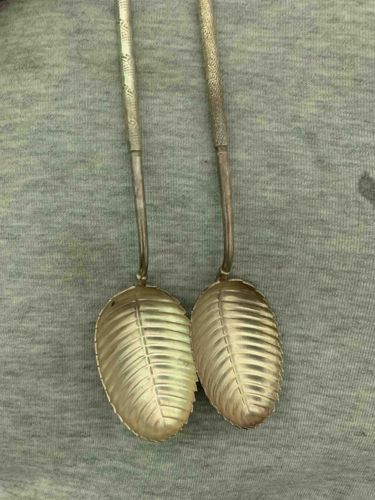
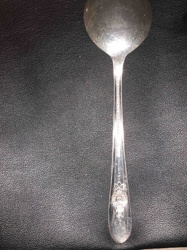
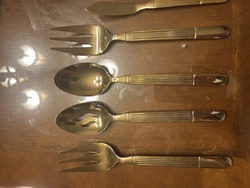
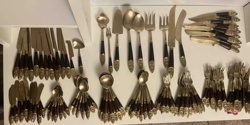
This item consists of a pair of antique or vintage strainer spoons, likely made by Wm. Rogers, judging by the provided context. Each spoon features a distinct leaf-shaped bowl with prominent, raised veins that simulate natural leaf textures. The bowls appear to be cast or stamped, given the uniform relief of the veins, and display a metallic luster, suggesting they are made of silver-plated brass or a similar silver alloy. The handles are long, slender, and appear to be made of the same material as the bowls. Both handles are decorated with an intricate, repeating engraved or embossed pattern that runs along their length, adding an elegant touch. The connection point between the handle and the bowl is gracefully curved. Given the function of a strainer, the leaf-shaped bowls likely have small, finely perforated holes, although these are not clearly visible in the provided image due to the angle and limited resolution. The overall condition appears to be good with a visible patina that suggests age and regular use, which is typical for silver-plated items of this vintage, indicating that they have not been recently polished. There are no obvious signs of major damage like dents or breaks, but minor surface scratches or wear commensurate with age could be present. The craftsmanship suggests a manufactured item from the late 19th to early 20th century, a period when Wm. Rogers was a prominent silverplate manufacturer. The design is decorative and functional, intended for serving, perhaps for tea, sugar, or other small food items that require straining.
AI Appraisal Report
Based on my examination of the image and the provided context that these are Wm. Rogers leaf-shaped strainer spoons, I've assessed their condition and potential value. Visually, the pair appears to be in good antique/vintage condition, displaying a desirable patina consistent with age and use, which I prefer over overly polished silverplate. The definition of the leaf veins and handle patterns seems largely intact, and I observe no obvious dents, breaks, or significant plating loss from the images. Minor surface scratches are to be expected with items of this age and function.
From a market perspective, Wm. Rogers silverplate, while collectible, is generally not considered rare. These specific leaf-shaped strainer spoons are charming and functional, appealing to collectors of antique kitchenalia, serving pieces, or general decorative arts. Demand exists, but it's not exceptionally high. Comparables typically sell in the range of $20-50 per spoon, sometimes more for a well-preserved pair or a particularly unusual design. The 'strainer' function adds a slight novelty factor.
Factors impacting value include the visible quality of the plating and the completeness of the set (though here it's a pair, which is good). The authenticity, based on the Wm. Rogers name, is highly probable given the typical patterns and manufacturing quality of the period. However, it is crucial to state that authenticity verification from images alone is limited. I cannot definitively confirm "Wm. Rogers" without physically inspecting for maker's marks, which are typically stamped on the underside of the handle or bowl. An in-person examination would allow me to check for all identifying marks, assess plating integrity more thoroughly, and gauge the actual weight and feel of the metal. Provenance documentation, such as original sales receipts, if available, would further solidify authenticity, though it's rare for such items. Scientific testing, like X-ray fluorescence (XRF), could confirm metal composition but is usually overkill for common silverplate items of this nature.