AI estimate as of July 29, 2025 · verify with a professional before acting
AI-Generated · Verify before acting
Everything on this page is generated by AI for informational purposes only. AI can make mistakes — the AI may misidentify items or misattribute them (artist, maker, brand, designer, origin, era). This is not an official valuation and should not be used for insurance, sale, tax, estate, legal, or lending purposes — or any decision requiring a certified appraisal. It is not an authoritative claim about any person, brand, or rights holder — do not share or rely on it as a factual statement about a third party. Always consult qualified professionals before making financial decisions.
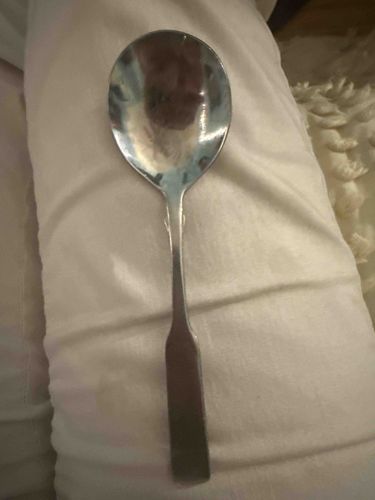
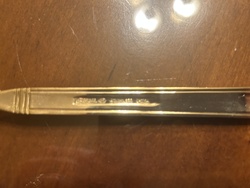
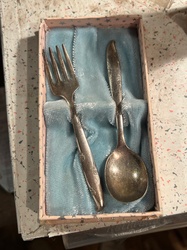
The item is a metal spoon, likely a table spoon or serving spoon, characterized by its reflective, silvery surface. Its overall aesthetic is simple and functional, lacking elaborate decorative elements. The spoon consists of a deep, oval-shaped bowl and a long, tapering handle. The connection point between the bowl and the handle appears to be slightly narrower, with a subtle transition, though no distinct shoulder or decorative joinery is visible. The handle itself is mostly flat and straight, widening slightly towards the base from the narrowest point just below the bowl, creating a simple, rectangular-like form at its end. There are no visible maker's marks, hallmarks, or other identifying stamps on the surface in the provided image. The material appears to be polished metal, possibly stainless steel or silver-plated metal, given its high reflectivity. The surface exhibits some smudges, fingerprints, and minor scuffs, indicating normal use or handling, but no significant dents, bends, or corrosion are immediately apparent. The reflective quality of the bowl also shows some indistinct reflections of the surrounding environment. Without clearer images of the reverse side or specific hallmarks, determining the exact age or precise material (e.g., sterling silver vs. stainless steel vs. silver plate) is challenging. However, its unadorned design suggests a practical, possibly modern or mid-20th century, aesthetic, rather than an ornate antique style. The craftsmanship points to a mass-produced item due to the lack of unique hand-worked details. The overall condition appears to be good for a used utensil, with expected superficial wear.
AI Appraisal Report
I have examined the provided image of this metal spoon. Visually, it appears to be a mass-produced table or serving spoon, likely crafted from stainless steel or silver-plated metal due to its high reflectivity and lack of tarnishing suggestive of sterling silver. The design is utilitarian and unadorned, suggesting a modern or mid-20th century origin.
Condition-wise, the spoon is in good used condition. I observe superficial smudges, fingerprints, and minor scuffs, which are consistent with typical use and handling. There are no apparent dents, bends, or significant corrosion visible. The absence of distinguishing marks, such as hallmarks or maker's stamps, is a critical factor limiting specific identification.
In terms of market conditions, un-hallmarked, simple metal spoons generally fall into the everyday flatware category. Comparables would be similar single pieces of stainless steel or silver-plated flatware available individually, rather than as part of a set. Demand for such single, non-collectible pieces is low, typically driven by replacement needs or for general kitchen use. Rarity is not a factor; this appears to be a common item.
Key factors significantly impacting value are the lack of verifiable material (e.g., sterling silver vs. stainless steel), the absence of maker's marks, and its generic, mass-produced design. Without these, the item lacks collectible appeal or intrinsic material value beyond scrap.
Limitations in authenticity and material verification are significant. Without physical inspection, I cannot definitively confirm the metal composition (e.g., sterling silver, silver plate, stainless steel), which profoundly impacts value. An in-person examination would allow for magnet testing (for steel), weight assessment, and microscopic inspection for hidden marks or plating wear. Provenance documentation could specify age or manufacturer, but none is available. Scientific testing, such as XRF analysis, would be necessary for precise material identification. Based solely on the image, it is most consistent with common, inexpensive cutlery.