AI estimate as of August 11, 2025 · verify with a professional before acting
AI-Generated · Verify before acting
Everything on this page is generated by AI for informational purposes only. AI can make mistakes — the AI may misidentify items or misattribute them (artist, maker, brand, designer, origin, era). This is not an official valuation and should not be used for insurance, sale, tax, estate, legal, or lending purposes — or any decision requiring a certified appraisal. It is not an authoritative claim about any person, brand, or rights holder — do not share or rely on it as a factual statement about a third party. Always consult qualified professionals before making financial decisions.
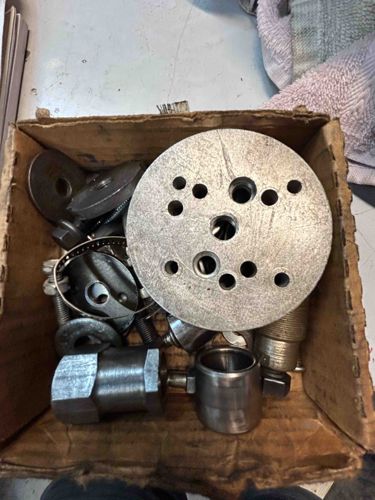
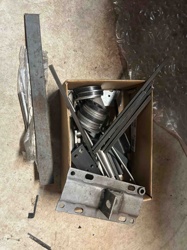
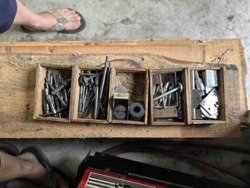
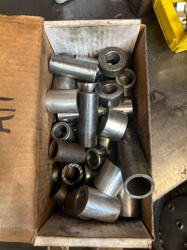
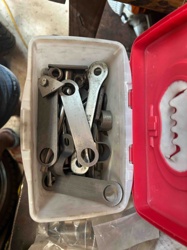
This item is a collection of various metal hardware and industrial components, stored haphazardly in an open cardboard box. The primary visible piece is a large, circular, flat metal disc, appearing to be made of aluminum or a similar light-colored alloy. It features numerous drilled holes of varying sizes, arranged in an irregular pattern, suggesting it may be a mounting plate, a part of a machinery assembly, or a specialized flange. The surface of this disc shows signs of use, including scratches and scuff marks, indicating it is not new. Other visible components include several smaller, dark-colored metal washers or discs, multiple screws and bolts of different dimensions, and two more substantial metal pieces. One of these larger pieces is a hexagonal-shaped nut or coupling made of a darker, possibly steel, material, showing some surface wear. The other is a cylindrical metal part with a hollow interior and a protruding connecting element, also appearing to be steel or a heavy alloy. The overall condition of the contents suggests they are used, surplus, or salvaged parts from machinery or industrial equipment. There are no obvious maker's marks or identifying signatures visible in the image. The style and construction appear functional and utilitarian, consistent with industrial or mechanical components, likely from the mid to late 20th century or possibly more recent, given the lack of significant rust or heavy patina on most pieces. The craftsmanship appears to be standard for machined metal parts, focusing on functionality rather than aesthetic appeal.
AI Appraisal Report
Based on my visual examination of the provided image, the Assorted Industrial Hardware and Machine Components appear to be a collection of used, utilitarian metal parts. The condition is consistent with surplus or salvaged industrial components; wear, scratches, and scuff marks are evident, but there's no significant rust or heavy deterioration. Authenticity, in terms of their intended use as industrial hardware, is high given their functional design. However, I cannot verify specific material compositions (e.g., aluminum vs. steel for the large disc) or precise dates of manufacture without physical inspection.
Market conditions for such miscellaneous industrial hardware are generally low, driven by utility rather than collector value. Comparables would be bulk industrial scrap metal, surplus equipment auctions, or specialized hardware suppliers. Demand is limited to individuals or businesses needing specific, common components for repair or prototyping, not for the collection as a whole. Rarity is negligible; these are common forms of hardware. Factors significantly impacting value are their used condition and the mixed, unorganized nature of the components. Without specific identification of unique or highly specialized parts, their value is primarily based on weight and material type for salvage or very low-cost reuse.
Limitations: My assessment is based solely on visual cues from the image. A physical examination would allow for precise material identification (e.g., specific alloy, hardness), accurate dimensioning, assessment of internal wear on parts like the cylindrical component, and identification of any hidden maker's marks. Provenance documentation could reveal their origin or original application, potentially adding context but unlikely significant monetary value. Scientific testing (e.g., metallurgical analysis) would be needed for definitive material specification. Without these, the appraisal remains conservative.