AI estimate as of August 8, 2025 · verify with a professional before acting
AI-Generated · Verify before acting
Everything on this page is generated by AI for informational purposes only. AI can make mistakes — the AI may misidentify items or misattribute them (artist, maker, brand, designer, origin, era). This is not an official valuation and should not be used for insurance, sale, tax, estate, legal, or lending purposes — or any decision requiring a certified appraisal. It is not an authoritative claim about any person, brand, or rights holder — do not share or rely on it as a factual statement about a third party. Always consult qualified professionals before making financial decisions.
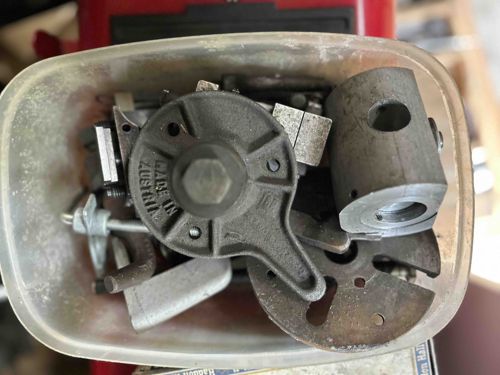
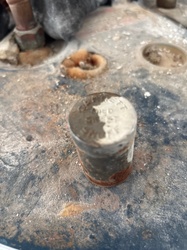
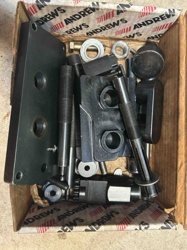
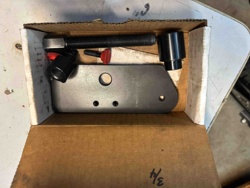
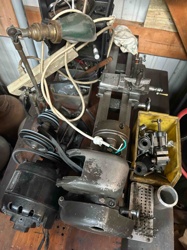
The image displays a collection of various metal components, likely machine parts or tooling, stored loosely within a translucent plastic container. The predominant material appears to be cast iron or a similar darkened, heavy-duty metal, exhibiting a matte, dark grey to black finish, indicative of natural patina and possible industrial use. One prominent component in the foreground is a circular, multi-holed disk with a central hexagonal bolt head, suggesting a rotary or mounting function. This piece has raised lettering that clearly reads "MADE IN AUSTRIA," indicating its country of origin. Another significant component is a cylindrical piece with a roughly textured, darkened surface, featuring a large circular aperture on its side and a threaded internal bore at one end. This piece suggests a housing, coupling, or fixture. Other visible elements include smaller, irregularly shaped metal pieces, some with what appear to be mounting brackets, levers, or clamping mechanisms. The overall condition of the items shows signs of age and use, including surface abrasions, dust accumulation, and a generalized patina consistent with ferrous metals exposed to air over time. There are no obvious signs of severe damage, cracks, or recent repairs, but rather the expected wear of functional industrial components. The craftsmanship appears robust and utilitarian, typical of precision-engineered industrial parts designed for durability rather than aesthetic appeal. Given the 'MADE IN AUSTRIA' marking and the style of the components, it is likely these parts date from the mid-20th century to possibly early 21st century, consistent with a period when such machinery was widely manufactured in European countries.
AI Appraisal Report
I have examined the provided image of these assorted industrial metal components, including the "MADE IN AUSTRIA" part. The items appear to be robust, utilitarian machine parts, likely cast iron or similar heavy-duty metal, showing typical signs of age and industrial use, such as surface abrasions and a generalized patina. There are no obvious signs of severe damage, indicating functional wear rather than breakage.
Authenticity: Based on the visual evidence, the "MADE IN AUSTRIA" marking appears consistent with manufacturing standards of the mid-20th to early 21st century. The part's style and apparent construction align with European industrial components from that era. However, without physical inspection, I cannot fully verify authenticity. An in-person examination would allow me to assess the material properties, weight, and subtle manufacturing details not visible in the image. Provenance documentation, such as original equipment manifests or maintenance records, would significantly aid in full authentication and dating. Scientific testing, like spectroscopic analysis for material composition, would provide definitive proof of authenticity and origin.
Market Conditions and Comparables: This collection falls into the industrial salvage, steampunk, or DIY/maker markets, where individual unique components can have niche appeal. Unless these parts are from highly sought-after or specialized machinery, their value is primarily in their material weight, or their potential for upcycling into art or functional pieces. They are not antique collectibles in the traditional sense, but rather functional industrial surplus. Comparable items would include bulk industrial scrap metal (lower end) or decorative/artistic metal elements (higher end if unique).
Demand and Rarity: Demand for such items is generally low unless they are specific replacement parts for rare machinery or are particularly visually striking for decorative purposes. Rarity would depend on the original machine they belong to, which is impossible to ascertain from the image. Generic industrial components are not rare.
Factors Impacting Value: The primary factors impacting value are the "MADE IN AUSTRIA" marking, which adds a degree of identifiable origin, and the robust, utilitarian nature of the parts. The overall condition, while showing wear, seems to indicate usability. Without detailed knowledge of their original function or specific material composition, the value remains limited. Their potential for artistic repurposing could add value for some buyers.
Limitations: My assessment is entirely based on a single image. I cannot assess scale, weight, specific material composition beyond visual estimation, or the internal condition of any bores or threads. Nor can I definitively confirm their original function or the exact manufacturing period without further information or physical inspection.