AI estimate as of August 8, 2025 · verify with a professional before acting
AI-Generated · Verify before acting
Everything on this page is generated by AI for informational purposes only. AI can make mistakes — the AI may misidentify items or misattribute them (artist, maker, brand, designer, origin, era). This is not an official valuation and should not be used for insurance, sale, tax, estate, legal, or lending purposes — or any decision requiring a certified appraisal. It is not an authoritative claim about any person, brand, or rights holder — do not share or rely on it as a factual statement about a third party. Always consult qualified professionals before making financial decisions.
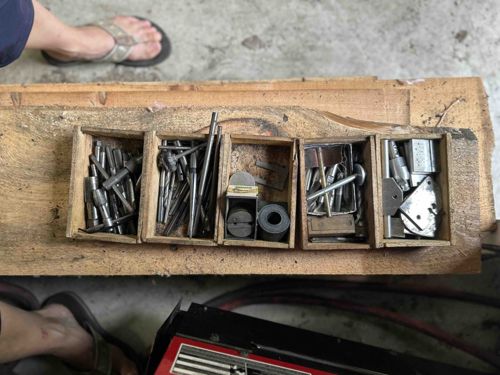
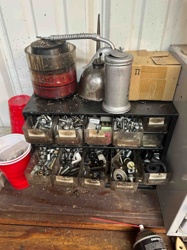
The item depicted is a collection of various metal components, likely tools, drill bits, and miscellaneous machinery parts, organized within five small, individual wooden boxes, which are themselves resting on a larger, rough-hewn wooden board or workbench. The wooden boxes appear to be simple, utilitarian constructions, possibly made from thin planks and showing signs of wear, including darkening of the wood and some minor splintering, indicative of age and regular use. The items contained within the boxes are predominantly metallic, exhibiting various shades of gray and black, suggesting materials such as steel, iron, or other alloys. Many of the components show a dull, oxidized patina, consistent with prolonged exposure and lack of recent polishing, but do not appear to have significant active rust that would compromise their structure. Visible items include what appear to be various sizes of drill bits, possibly reamers or other cutting tools (specifically in the first two boxes from the left), fasteners like bolts or screws, and a assortment of irregularly shaped mechanical parts with visible threads, shafts, and flat surfaces in the other boxes. There are no obvious maker's marks or signatures discernible from the given image, which is common for bulk-bought or generic tool components. The overall presentation suggests a functional, working environment, possibly a home workshop or garage, rather than a display or collectible set. The items are not uniformly clean or polished, rather they possess a 'used' aesthetic, contributing to an estimated age from the mid-20th century to more recent, depending on the specific application of these parts. The craftsmanship appears robust and industrial, designed for function rather than aesthetic appeal.
AI Appraisal Report
I have examined the image provided depicting Assorted Metal Workshop Components in Wooden Boxes. The collection presents as a practical assortment of metal components, including drill bits, fasteners, and various mechanical parts, housed within five unassuming wooden boxes on what appears to be a workbench. The condition of both the components and the boxes suggests a used, functional environment rather than a curated collection. The metal items exhibit a dull, oxidized patina consistent with age and use, but no significant active rust indicating structural compromise. The wooden boxes show signs of wear, splintering, and darkening, further supporting their utilitarian purpose.
Authenticity, based solely on visual examination, appears to be that of genuine workshop items, as expected for such generic components. There are no discerning maker's marks, which is typical for bulk or common industrial parts. The items' robust and industrial craftsmanship points to functionality over aesthetic.
In terms of market conditions, similar assortments of used metal components, especially common drill bits, fasteners, and miscellaneous machine parts, tend to have limited market appeal as collectible items. Their value is primarily driven by their utility for hobbyists, mechanics, or small workshops seeking replacement parts or building materials. Comparables would include lots of 'scrap metal' or 'parts bins' sold at unreserved auctions, yard sales, or online marketplaces. The demand for such a generic assortment is modest and driven by specific utilitarian needs rather than rarity or historical significance. The lack of specific identification or high-value materials (e.g., precious metals, rare alloys) significantly impacts value.
To definitively authenticate and assess the precise nature of the metals or specific use-cases of some parts, in-person examination, including potential material testing (e.g., specific gravity, magnetic properties tests for general alloy identification), and detailed measurement of components, would be beneficial. Provenance documentation, while unlikely for such items, could provide context regarding their origin or previous use. However, for a generic collection of workshop components, such in-depth analysis is rarely economically justified.
Given the unspecific nature of the components, their used condition, and the lack of collectible appeal, the value is primarily based on their bulk weight as useful but common metal items.