AI estimate as of August 7, 2025 · verify with a professional before acting
AI-Generated · Verify before acting
Everything on this page is generated by AI for informational purposes only. AI can make mistakes — the AI may misidentify items or misattribute them (artist, maker, brand, designer, origin, era). This is not an official valuation and should not be used for insurance, sale, tax, estate, legal, or lending purposes — or any decision requiring a certified appraisal. It is not an authoritative claim about any person, brand, or rights holder — do not share or rely on it as a factual statement about a third party. Always consult qualified professionals before making financial decisions.
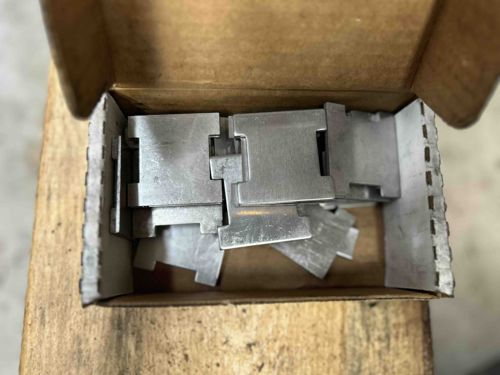
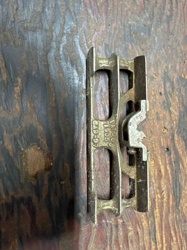
The image displays a collection of what appear to be sheet metal stamping parts, presented within an open cardboard box. Each piece is constructed from a flat, silvery-grey metal, likely aluminum or a light-gauge steel, exhibiting a brushed or satin finish. The individual components are generally rectangular in shape, approximately 2-3 inches in length and 1-2 inches in width, with precisely cut notches and tabs on their edges. These features suggest they are designed to interlock or attach to other components. The edges of the stamped parts appear clean and well-defined, indicative of a professional manufacturing process such as die-cutting or punching. There are no obvious signs of rust or significant corrosion, although some pieces show minor superficial scratches and scuffs, which is common for bulk-packaged metal parts. The box itself is a standard corrugated cardboard, suggesting these are new or unused components awaiting further assembly or distribution. No specific manufacturer's marks or identifying stamps are visible on the components themselves, nor on the interior of the box. The overall impression is one of mass-produced industrial parts, likely recent in manufacture given their clean appearance and lack of heavy patina. The craftsmanship seems consistent, with uniform cuts and bends, suggesting a high degree of precision in their fabrication.
AI Appraisal Report
Based on my visual examination of the image, the Sheet Metal Stamped Components appear to be in excellent, unused condition. The parts exhibit clean cuts, consistent uniformity, and no significant rust or corrosion, suggesting recent manufacture and good storage. The minor superficial scratches and scuffs are typical for bulk-packaged metal parts and do not diminish their functional value. Authenticity, in this context, relates to them being genuine manufactured components rather than counterfeits; their uniform appearance and professional finish support their authenticity as industrial parts. However, without manufacturer marks, I cannot link them to a specific brand or origin from the image alone.
Market conditions for generic sheet metal stamped components are driven by industrial demand for manufacturing and assembly. These are not rare items; they are mass-produced commodity parts. Their demand is consistent within various industries requiring fastening or structural elements. The value is primarily tied to material cost (likely aluminum or light-gauge steel) and the manufacturing process (stamping, which is cost-effective for high volumes). Comparables would be similar generic stamped components sold in bulk, often priced per piece or per weight.
Factors significantly impacting value include the material type and thickness, the precision of the cuts, the quantity available (which appears substantial here), and any specific certifications if required for specialized applications (e.g., aerospace, medical). Without knowing the exact alloy, thickness, or specific application, precise valuation is challenging.
Limitations in authenticity verification from images alone are significant. I cannot physically assess material type, exact dimensions, or internal structural integrity. Full authentication, if required for a specific high-precision application, would necessitate in-person examination to verify material composition via spectroscopy (e.g., XRF), precise dimensional measurement, and potentially mechanical testing (e.g., hardness, tensile strength). Provenance documentation, such as purchase orders or manufacturing specifications, would also be crucial to confirm their intended use and origin. Without such details, the appraisal remains focused on their apparent commodity value.