These notes were written by the person who submitted this item. Appraiser.AI has not verified them, and the AI's identification and estimate may rely on them.
AI Estimated Value
Not an official valuation
$50 - $100
AI estimate as of November 10, 2025 · verify with a professional before acting
AI-Generated · Verify before acting
Everything on this page is generated by AI for informational purposes only. AI can make mistakes — the AI may misidentify items or misattribute them (artist, maker, brand, designer, origin, era). This is not an official valuation and should not be used for insurance, sale, tax, estate, legal, or lending purposes — or any decision requiring a certified appraisal. It is not an authoritative claim about any person, brand, or rights holder — do not share or rely on it as a factual statement about a third party. Always consult qualified professionals before making financial decisions.
This analysis also relies on unverified notes provided by the user, which may be incomplete or inaccurate and could affect the result.
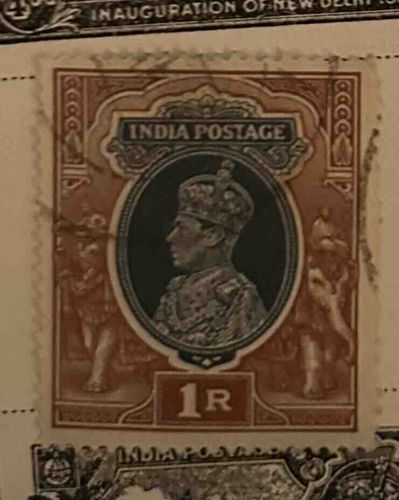
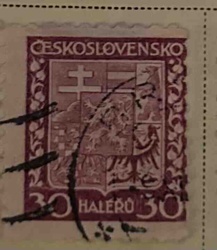
This item is an Indian postage stamp featuring a portrait of King George V. The stamp is predominantly reddish-brown with a black central oval depicting the king in profile, facing left. He is shown wearing a crown and what appears to be ceremonial robes, indicative of his royal status. The words "INDIA POSTAGE" are clearly visible at the top of the stamp, above the oval portrait. Below the portrait, centered within the design, is the denomination "1R", signifying one Rupee. The stamp's design elements include ornate scrollwork and decorative motifs surrounding the central portrait, giving it a classic colonial philatelic aesthetic. On either side of the portrait, faint outlines of figures or architectural elements can be discerned, though they are not perfectly clear in the provided image. The edges of the stamp exhibit typical perforations, suggesting it was part of a larger sheet. The overall condition appears used but reasonably well-preserved, with some minor discoloration consistent with age and handling. There are no obvious tears or significant creases visible, and the perforations seem intact. The style indicates it belongs to the period of British rule in India, likely from the early to mid-20th century. The quality of printing suggests a standard governmental issue for postal services.
AI Appraisal Report
Based on my visual examination of the provided image, this is a King George V India Postage Stamp, specifically the one Rupee denomination. The reddish-brown color with the black central portrait is characteristic of this issue. The 'INDIA POSTAGE' inscription and '1R' denomination are clearly visible.
My assessment of the condition is that it appears used, as evidenced by the cancellation, though the impression isn't clear enough to fully identify it. It seems reasonably well-preserved, with no obvious tears or significant creases, and the perforations appear intact. Minor discoloration consistent with age and handling is present. Authenticity, based solely on the image, appears strong as it matches known designs for this stamp. However, definitive authenticity requires in-hand inspection to check paper type, watermarks, gum condition (if unused), and printing methods, which cannot be determined from a photograph.
Market conditions for common King George V Indian stamps are generally stable but not highly speculative. While the '1R' denomination is higher, these stamps were produced in significant quantities. Comparables suggest that used specimens in good condition typically fetch modest prices. Demand is consistent among British Commonwealth and Indian philatelic collectors, but it’s not considered a rare stamp. Factors impacting value include the clarity of the cancellation, absence of defects such as thinning or repairs, and gum condition if it were unused.
To fully authenticate and precisely value this stamp, an in-person examination is crucial. This would allow me to inspect the paper for watermarks (essential for differentiating printings), assess the gum (if present), analyze the specific shade of reddish-brown, and examine the perforation gauge thoroughly. Provenance documentation, though unlikely for such a common stamp, would also add value. Without physical inspection, any exact valuation remains an estimate.