AI estimate as of November 10, 2025 · verify with a professional before acting
AI-Generated · Verify before acting
Everything on this page is generated by AI for informational purposes only. AI can make mistakes — the AI may misidentify items or misattribute them (artist, maker, brand, designer, origin, era). This is not an official valuation and should not be used for insurance, sale, tax, estate, legal, or lending purposes — or any decision requiring a certified appraisal. It is not an authoritative claim about any person, brand, or rights holder — do not share or rely on it as a factual statement about a third party. Always consult qualified professionals before making financial decisions.
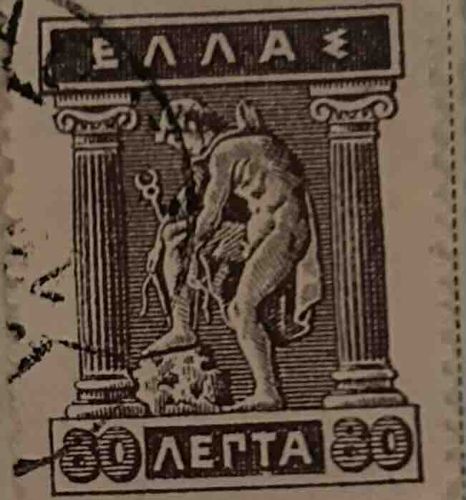
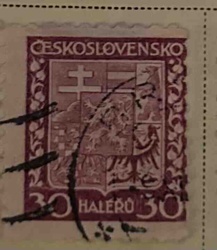
This item is an antique Greek postage stamp featuring the iconic Hermes Type design. The stamp is a light tan or off-white color with the primary design printed in a rich, dark sepia-toned ink, possibly brown or black. The central motif depicts a classical male figure, presumed to be Hermes, in a dynamic pose. He appears to be partially draped, with muscular anatomy clearly visible, and is holding what looks like a caduceus, a staff entwined with two serpents, in his left hand. His right hand is resting on a small, winged object or perhaps a helmet, which is placed on a rocky ground or pedestal. The figure stands between two fluted columns with Ionic capitals, indicative of classical Greek architecture, suggesting a temple or ancient building setting. Above the columns, a rectangular banner prominently displays the word "ΕΛΛΑΣ" (Hellas), meaning Greece, in capital letters. At the bottom, another rectangular banner features the denomination "80 ΛΕΓΓΤΑ 80" where "ΛΕΓΓΤΑ" translates to "Lepta," the Greek currency unit, and "80" is repeated on either side of the word. The stamp has perforations along its right edge, though the left side shows what appears to be a straight edge, possibly indicating it was torn from a sheet or a book of stamps. The overall condition shows signs of age and wear; there is a clear black cancelation mark, a common postmark, partially obscuring the upper left corner and extending diagonally across the central figure. There are also visible dark lines or creases, particularly in the lower left portion and across the figure's body, which could be folds or paper imperfections. The printing quality appears to be consistent with early philatelic production, showcasing fine line work for the details of the figure and architectural elements. The artistic style is neoclassical, typical of stamps from the late 19th or early 20th century to evoke a sense of national pride and classical heritage.
AI Appraisal Report
This Hermes Type Greek Postage Stamp (80 Lepta) exhibits characteristics consistent with authentic issues from the late 19th or early 20th century, particularly given the classical design, "ΕΛΛΑΣ" (Hellas) and "80 ΛΕΠΤΑ 80" denomination. The sepia-toned ink and printing quality appear typical for the period. The perforations on the right and what seems to be torn or straight edge on the left suggest it was part of a larger sheet. \
\
However, the stamp's condition significantly impacts its value. There is a prominent black cancelation mark partially obscuring the upper left and central figure, which substantially diminishes philatelic value. Furthermore, visible creases and possible paper imperfections, especially in the lower left and across the figure's body, denote wear and tear. While these stamps are historically significant, the 80 Lepta denomination, especially in used condition with a heavy cancel and visible flaws, is not considered rare. Numerous examples exist in various conditions. Market demand for heavily canceled and flawed examples is generally modest among serious collectors who prioritize fine or very fine condition. \
\
For a more definitive valuation and authentication, an in-person examination is crucial. This would allow for a precise assessment of paper type, watermarks (if any), cancellation details, gum condition (if applicable), and accurate color verification. Microscopic analysis could confirm printing techniques and rule out modern reproductions. Furthermore, provenance documentation would provide invaluable context regarding the stamp's history and authenticity. Based on the visual assessment alone, and assuming authenticity given the details observed, the condition significantly limits its market appeal.