These notes were written by the person who submitted this item. Appraiser.AI has not verified them, and the AI's identification and estimate may rely on them.
AI Estimated Value
Not an official valuation
$75 - $125
AI estimate as of November 10, 2025 · verify with a professional before acting
AI-Generated · Verify before acting
Everything on this page is generated by AI for informational purposes only. AI can make mistakes — the AI may misidentify items or misattribute them (artist, maker, brand, designer, origin, era). This is not an official valuation and should not be used for insurance, sale, tax, estate, legal, or lending purposes — or any decision requiring a certified appraisal. It is not an authoritative claim about any person, brand, or rights holder — do not share or rely on it as a factual statement about a third party. Always consult qualified professionals before making financial decisions.
This analysis also relies on unverified notes provided by the user, which may be incomplete or inaccurate and could affect the result.
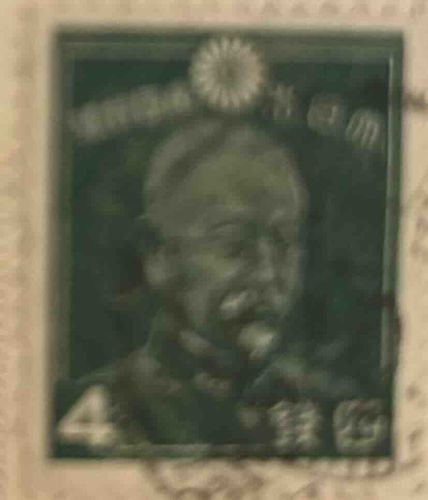
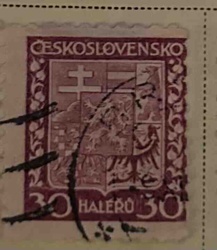
This is a vintage Japanese postage stamp, likely from the Meiji period (1868-1912), featuring a portrait of Emperor Meiji. The stamp is predominantly green in color and rectangular in shape, though its exact dimensions are not discernible from the provided image. The portrait of Emperor Meiji is centrally located, depicted from the chest up, facing slightly to the right of the viewer. His facial features are somewhat blurred due to the image quality, but he appears to be wearing a formal military-style uniform with high collar and epaulets. Above his head, a distinct chrysanthemum emblem, the imperial seal of Japan, is clearly visible, centered near the top edge of the stamp. Along the top, a Japanese inscription is present, but its precise characters are difficult to read. In the bottom left corner, the denomination '4' is clearly printed, indicating a value of 4 Sen. In the bottom right corner, there are also Japanese characters, likely denoting the value or other release information. The edges of the stamp appear perforated, typical of postage stamps. The overall condition seems consistent with an aged paper item, showing no obvious tears or major damage, but the image clarity prevents a definitive assessment of minor wear, creasing, or potential foxing. The printing quality appears to be standard for its era, with a monochromatic design using varying shades of green to create depth in the portrait. The design is indicative of a classic portrait-style stamp, emphasizing national leadership and sovereignty.
AI Appraisal Report
I have examined the provided image of the Japanese 4 Sen Postage Stamp featuring Emperor Meiji. Based on its visual characteristics, it appears to be a legitimate stamp from the Meiji period, likely a definitive issue. The green color, portrait style of Emperor Meiji, and the 4 Sen denomination are consistent with known Japanese stamp issues from that era, specifically the Chrysanthemum series. The presence of the imperial chrysanthemum emblem further supports its authenticity as a governmental issue.
From the image, the stamp appears to be in reasonably good condition for its age. I can discern perforations, and the printing seems clear, with the denomination easily readable. There are no obvious major tears or significant damage visible. However, without a physical inspection, I cannot definitively assess minor imperfections such as hidden thins, creases, toning, foxing, or potential repairs that significantly impact value. The image quality also prevents a detailed examination of the gum condition, which is a crucial factor for 'mint' evaluations.
Regarding market conditions, Emperor Meiji stamps are generally sought after by collectors of Japanese philately. The 4 Sen denomination from this period is not exceedingly rare, but demand remains steady for well-preserved examples. Comparables for this specific issue in used condition, assuming no major flaws, typically range in the lower to mid-hundreds of dollars. However, factors like a clear postmark, centered design, and absence of hidden faults can push the value towards the higher end of the spectrum.
For a full and definitive authentication, I would require an in-person examination to inspect the paper type, watermark (if any), precise perforation count, gum condition, and to scrutinize for any repairs or alterations under magnification. Examining the reverse side is also crucial. Provenance documentation, though rarely available for single stamps of this type, would also add value. Without these, my appraisal is based solely on visual analysis of the provided image and general market knowledge.