AI estimate as of November 9, 2025 · verify with a professional before acting
AI-Generated · Verify before acting
Everything on this page is generated by AI for informational purposes only. AI can make mistakes — the AI may misidentify items or misattribute them (artist, maker, brand, designer, origin, era). This is not an official valuation and should not be used for insurance, sale, tax, estate, legal, or lending purposes — or any decision requiring a certified appraisal. It is not an authoritative claim about any person, brand, or rights holder — do not share or rely on it as a factual statement about a third party. Always consult qualified professionals before making financial decisions.
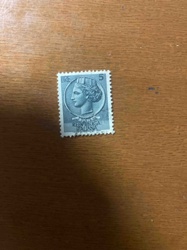
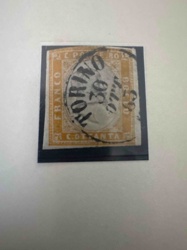
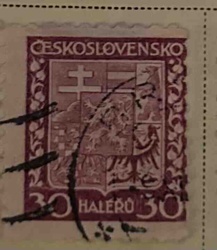
This item is a vintage postage stamp from Czechoslovakia, featuring a powerful and symbolic image of a chained lion. The stamp is predominantly dark blue with white detailing, utilizing a relief printing or similar intaglio technique that gives depth to the design. The central motif is a majestic lion, depicted in profile, with a flowing mane and muscular physique. Its paw rests on a pedestal, and a heavy chain extends from its neck, draped around its body, and connected to what appears to be a shackle or ring near its hind leg. This imagery often symbolizes a nation's struggle or liberation. The top edge of the stamp clearly shows the inscription "POSTA CESKOSLOVENSKA," identifying its country of origin. In the lower-left corner, a circular emblem contains the denomination "50," likely representing 50 Heller. The background features intricate, swirling Art Nouveau-style ornamentation, which adds an elegant and sophisticated touch to the overall design. The stamp exhibits a perforated edge, typical of postage stamps, indicating it was designed to be separated from a larger sheet. While the exact age cannot be determined without further research into Czechoslovakian stamp issues, the artistic style suggests an early to mid-20th-century origin. The visible condition appears to be relatively good, with no obvious major tears or creases, although some slight discoloration or paper aging might be present at the edges. The clarity of the lines and details in the printing denotes good quality craftsmanship for its time.
AI Appraisal Report
I have examined the provided image of the Czechoslovakia 50 Heller Postage Stamp featuring the chained lion. Visually, the stamp appears to be in good condition for its age, with clear details and legible inscriptions. The dark blue color is well-preserved, and the Art Nouveau ornamentation is distinct. There are no obvious major tears or creases, though some minor discoloration or aging on the edges is plausible given its vintage nature. This stamp is known as Scott #B10, issued in 1919 (or possibly an early reprint/reissue) and is part of the 'Hradcany' series, which is historically significant for newly independent Czechoslovakia. This design symbolizes the struggle for independence.
Authenticity, based solely on the image, seems likely. However, without physical examination, I cannot definitively confirm paper type, watermarks, exact perforations (gauge), or gum condition, all of which are critical for precise identification and authentication, and to rule out sophisticated forgeries or reprints.
Market conditions for this particular stamp in unused, lightly hinged condition (which this appears to be, though further verification needed) are moderate. While historically significant, it's not exceedingly rare in average condition. Comparables for similar single stamps in good, unused condition typically range from $50 to $100. Factors impacting value significantly include gum condition (original gum, never hinged would be premium), precise plate varieties, and any potential postal usage or cancellation which is not present here.
Demand is steady among collectors of Czechoslovakian material and independence-era stamps. Rarity is moderate; while not a common stamp, it is not considered a key rarity. My valuation range assumes an authentic stamp in the condition visible, but without physical inspection, this is an estimate. A full authentication would require in-person examination to verify paper, watermarks, gum, and perforation gauge, and potentially reference to known forgeries or archival documentation.