AI estimate as of December 8, 2025 · verify with a professional before acting
AI-Generated · Verify before acting
Everything on this page is generated by AI for informational purposes only. AI can make mistakes — the AI may misidentify items or misattribute them (artist, maker, brand, designer, origin, era). This is not an official valuation and should not be used for insurance, sale, tax, estate, legal, or lending purposes — or any decision requiring a certified appraisal. It is not an authoritative claim about any person, brand, or rights holder — do not share or rely on it as a factual statement about a third party. Always consult qualified professionals before making financial decisions.
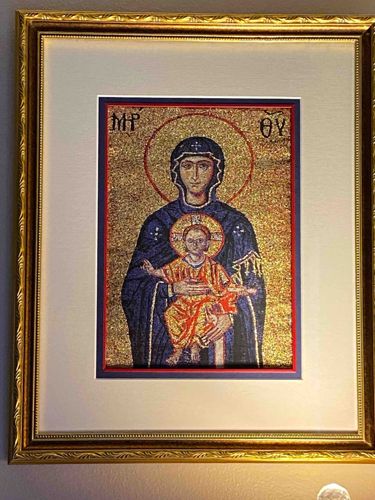
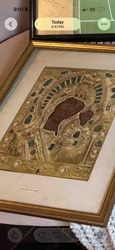
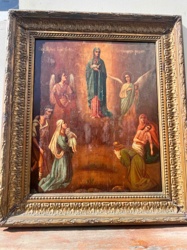
This item is a framed icon depicting the Virgin Mary holding the Christ Child, rendered in a Byzantine mosaic style. The image itself appears to be a print or reproduction of a mosaic, rather than an actual mosaic composed of individual tesserae, as indicated by the uniform texture and lack of perceptible depth irregularities expected from a true mosaic. The main figures are set against a shimmering gold background, characteristic of traditional Byzantine iconography, symbolizing divine light and heaven. The Virgin Mary is depicted wearing a dark blue maforion (mantle) with red accents and several visible crosses, while the Christ Child is adorned in bright orange-red garments, also with gold detailing, holding what appears to be a scroll or book. Both figures have halos, delineated in red against the gold background, and are presented frontally. The composition features Greek abbreviations 'MP ΘV' (Μήτηρ Θεοῦ, 'Mother of God') above the Virgin's shoulders, typical for such icons. The icon is framed within a series of matting layers: a narrow red inner mat, followed by a slightly wider dark blue mat, and then a broad, light-colored (likely off-white or cream) outer mat. The entire piece is housed in an ornate, gilded wooden frame with a decorative, possibly carved or molded, pattern along its inner and outer edges, suggesting a traditional or classic aesthetic. The frame appears to be in good condition with minor signs of wear consistent with age or handling, such as slight tarnishing or scuffs on the gold finish. The overall presentation is formal and reverent, aligning with the religious subject matter. Given the likely print nature, its estimated age would be more contemporary, possibly late 20th to early 21st century, rather than an antique, though it faithfully reproduces an ancient style. The craftsmanship of the framing and matting appears professional, enhancing the visual appeal of the icon.
AI Appraisal Report
I have examined the provided image of this framed icon depicting the Virgin Mary and Christ Child. My assessment indicates this is a reproduction, likely a print, of a Byzantine-style mosaic, rather than an actual mosaic composed of individual tesserae. This is evidenced by the uniform texture visible in the image, lacking the distinct dimensionality and irregularities inherent in true mosaic work. The print quality appears good, faithfully reproducing the iconography including the gold background, symbolic colors, halos, and Greek abbreviations 'MP ΘV'.
The item is presented in a professional manner, featuring multi-layered matting (red, dark blue, and light-colored) and an ornate, gilded wooden frame. The frame appears to be in good condition with only minor signs of wear such as slight tarnishing or scuffs, consistent with careful handling over time. The overall presentation enhances the decorative and reverent aesthetic of the piece.
Market conditions for reproductions of religious art, even well-framed ones, are generally modest. Comparables in the secondary market typically include framed religious prints or decorative icons. Demand for such items is consistent but not high, primarily from individuals seeking devotional art or decorative pieces with religious themes. Rarity is not a factor here; reproductions of iconic religious images are widely available.
Factors significantly impacting value include its nature as a print rather than an original mosaic or painting, which limits its artistic and historical value. Its value is predominantly decorative and sentimental. The quality of the framing and presentation certainly adds to its appeal and contributes to the higher end of its estimated range.
Limitations in authenticity verification from images alone are significant. While I can confidently assess this as a print based on visual cues, a full authentication for its age and print method would require in-person examination. Specifically, examination under magnification to assess print registration and dot patterns, testing of materials, and direct inspection for any artist's marks or publisher information would be crucial for a more definitive assessment of its origin and age. Without physical inspection, I cannot confirm the exact printing technique or the precise age, only that it is likely contemporary (late 20th to early 21st century).