AI Appraisal Estimate

AI-generated estimates · not official valuations

From the user

What was submitted

Photo and notes provided by the user — not generated by AI

Submitted item photo
Submitted photo · June 15, 2026

User's notes

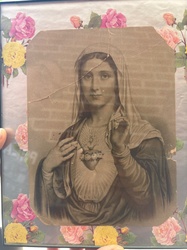
Saved from a church fire in Mexico City. Appears to be printed on linen

AI analysis below

AI appraisal

AI analysis & estimate

AI-Generated · Verify before acting

Everything below is generated by AI for informational purposes only. AI can make mistakes — the AI may misidentify items or misattribute them (artist, maker, brand, designer, origin, era). This is not an official valuation and should not be used for insurance, sale, tax, estate, legal, or lending purposes — or any decision requiring a certified appraisal. It is not an authoritative claim about any person, brand, or rights holder — do not share or rely on it as a factual statement about a third party. Always consult qualified professionals before making financial decisions.

Note

This analysis also relies on unverified notes provided by the user, which may be incomplete or inaccurate and could affect the result.

Read the full disclaimer

AI Identification

·Not independently authenticated·Verify before acting

Religious Iconography Panel on Linen

Antique Religious Art & Textiles

AI Estimated Value

·Not an official valuation·Verify before acting

$450.00 - $650.00

As of June 15, 2026

AI Item Analysis

·AI can make mistakes·Verify before acting
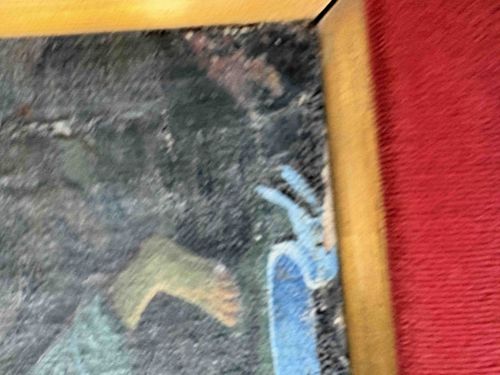
This artifact is a religious textile panel, likely a fragment of a larger liturgical hanging or altarpiece, appearing to be printed or painted on a heavy linen substrate. The image features stylized figures in a palette of muted greens, earth tones, and vibrant cornflower blue highlights. Physically, the piece demonstrates a coarse weave characteristic of mid-to-late period linens. The craftsmanship leans toward folk-devotional art, common in Latin American colonial or post-colonial ecclesiastical settings. Conservation-wise, there is significant surface abrasion and fraying at the margin where the textile meets the yellow-toned wooden frame. Darkened spots, possibly soot or smoke damage consistent with the provided history of a church fire, are visible across the surface. Patina is uneven, with significant fading of pigments and localized staining. No clear maker's marks or signatures are visible in this specific corner detail, but the style suggests a Mexican origin, potentially dating from the 19th or early 20th century. The blue pigment retains remarkable saturation compared to the surrounding earth tones, indicating the possible use of indigo or a similar stable mineral pigment. The inclusion of the wooden frame suggests a later effort to preserve the surviving fragment.
AI Appraisal Report

·AI can make mistakes·Verify before acting
I have carefully examined the provided details for this Mexican devotional textile fragment. The piece exhibits characteristics consistent with 19th or early 20th-century folk-liturgical art. The use of a coarse-weave linen substrate and the vibrant survival of the blue pigment—likely a stable mineral or indigo-based dye—supports a colonial or early post-colonial identification. From a conservation standpoint, the item shows significant distress; however, the soot staining and smoke-darkened patina align with the stated provenance of being salvaged from a church fire, which adds historical narrative value but complicates the physical stability of the textile. The current market for Latin American devotional fragments is stable, though buyers prioritize condition and scale. While the fire damage is a compelling historical marker, the resulting surface abrasion and pigment loss cap the market value compared to pristine examples. Similar fragments of this size and period typically fluctuate between $400 and $700 at auction. The frame, while protective, appears to be a later addition and does not contribute significantly to the intrinsic value of the textile. It is important to note that this appraisal is based solely on digital representation and provided history. Visual inspection cannot confirm if the image is a woodblock print or manual polychrome painting. A full authentication would require in-person examination to assess weave density, fiber UV reaction, and chemical analysis of the pigments. To solidify the high end of this valuation, I would recommend seeking archival documentation or parish records from Mexico City that link this specific salvage event to a known historical fire.

Get your items appraised

Instant estimates of your treasures with AI-powered appraisals

Browse More Appraisals