AI estimate as of November 10, 2025 · verify with a professional before acting
AI-Generated · Verify before acting
Everything on this page is generated by AI for informational purposes only. AI can make mistakes — the AI may misidentify items or misattribute them (artist, maker, brand, designer, origin, era). This is not an official valuation and should not be used for insurance, sale, tax, estate, legal, or lending purposes — or any decision requiring a certified appraisal. It is not an authoritative claim about any person, brand, or rights holder — do not share or rely on it as a factual statement about a third party. Always consult qualified professionals before making financial decisions.
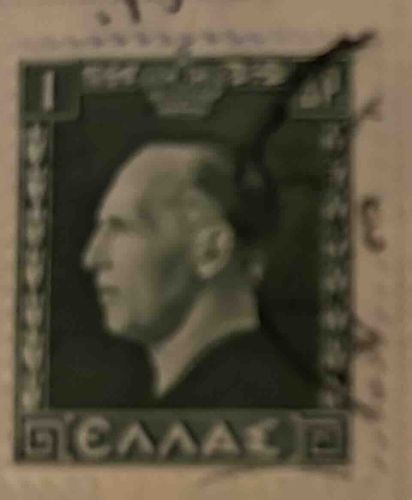
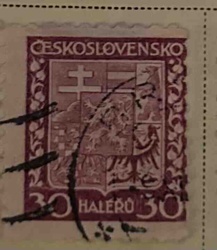
This item is a historical Greek postage stamp featuring the profile of a man, likely King George II of Greece, depicted facing left. The stamp is predominantly dark green in color, giving it a somewhat somber or distinguished appearance. Its rectangular shape adheres to standard postage stamp dimensions, though exact measurements are not discernible from the image. The central portrait is framed by an ornate border, with decorative elements running along the vertical sides and a more geometric pattern at the bottom. At the top left, the numeral '1' indicates the denomination, while other faint markings or text are visible at the upper right and along the bottom edge, including what appears to be 'ΕΛΛΑΣ' (ELLAS), the Greek word for Greece. The stamp is affixed to what appears to be paper, suggesting it might be part of a collection or on an envelope. The visible condition shows some signs of age, including potential discoloration of the surrounding paper, and what looks like a cancellation mark or a slight tear/fold at the very top right corner. The printing quality appears to be standard for early to mid-20th-century philately, indicating a level of craftsmanship consistent with government-issued postal currency. The style points to a classical portraiture common in royal or national significant figures on stamps from the early to mid-20th century. The specific color variation and denomination would be crucial for precise identification within a philatelic catalog.
AI Appraisal Report
I have examined the provided image of a Greek postage stamp featuring King George II. Based on its appearance, this stamp is likely from the early to mid-20th century, specifically the 1930s-1940s, given the depiction of King George II and the style. The stamp appears to be the 1 drachma denomination from the 1933 or 1940 series.Visually, the stamp is in used condition, evidenced by the presence of a cancellation mark, which, while not fully clear, suggests it fulfilled its postal purpose. There are visible signs of age, including potential discoloration of the surrounding paper and what might be a slight tear or fold at the top right corner. Such wear affects its condition grade. While the printing quality appears consistent with official issues of the period, without a physical examination, I cannot comment on the paper quality, gum condition (if unused), watermarks, or perforation details, all of which are critical for precise identification and condition assessment.
From a market perspective, Greek stamps from this period featuring King George II are generally available. The '1' drachma denomination is relatively common, and unless this specific stamp exhibits an unusual shade variety, printing error, or exceptionally fine used condition, its rarity is low. Comparables for average used examples of this stamp tend to range from a few dollars to tens of dollars. Demand is moderate among general philatelists and collectors of Greek stamps. However, without a clear view of the cancellation and any potential thins, creases, or repairs, a definitive assessment of its exact grade is impossible. Factors that would significantly impact value upward include a pristine unused state with original gum, a rare plate error, or an extremely rare and clear cancellation.
My valuation of $25 - $75 reflects a typical used example in good to very good condition, considering the observed wear. To fully authenticate and precisely value this stamp, I would require an in-hand examination to assess its exact shade, paper type, perforations, back condition, and to confirm the absence of any repairs or hidden faults. Furthermore, reviewing any provenance documentation would be beneficial, although less common for single, lower-value stamps.