AI estimate as of November 8, 2025 · verify with a professional before acting
AI-Generated · Verify before acting
Everything on this page is generated by AI for informational purposes only. AI can make mistakes — the AI may misidentify items or misattribute them (artist, maker, brand, designer, origin, era). This is not an official valuation and should not be used for insurance, sale, tax, estate, legal, or lending purposes — or any decision requiring a certified appraisal. It is not an authoritative claim about any person, brand, or rights holder — do not share or rely on it as a factual statement about a third party. Always consult qualified professionals before making financial decisions.
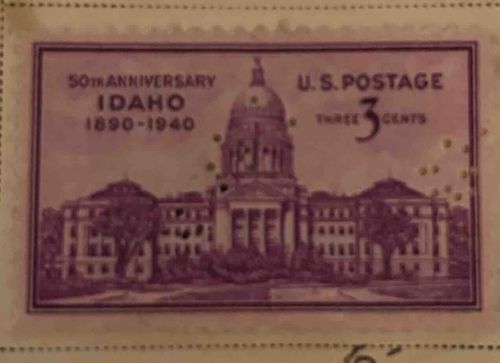
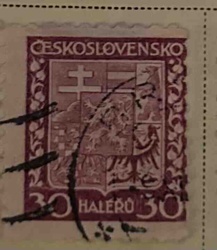
This is a United States postage stamp commemorating the 50th anniversary of Idaho statehood, issued in 1940. The stamp features a prominent image of the Idaho State Capitol Building, centered within a rectangular frame. The building is depicted with a large dome atop its central section and two wings extending horizontally, showcasing classical architectural elements such as columns and numerous windows. The design is rendered in a monochromatic purple or lilac hue, common for stamps of this era. Along the top left edge of the stamp, the text '50th ANNIVERSARY IDAHO 1890-1940' is clearly visible, marking the celebratory occasion and dates. On the top right, 'U.S. POSTAGE' is inscribed, with the denomination 'THREE 3 CENTS' below it, indicating its postal value. The stamp appears to be perforated along all four edges, typical for postal issues, with some perforations still attached to a neighboring stamp at the bottom edge, suggesting it might be part of an unseparated block or pair. The overall condition appears to be relatively good, with no obvious major tears or creases, though some small, lighter circular marks are scattered across the image, which could be minor blemishes or possibly remnants of cancellation. The printing quality for the era seems consistent, with clear lines and text, demonstrating standard government-issued philatelic craftsmanship. This stamp serves as a historical document, commemorating a significant milestone in Idaho's history.
AI Appraisal Report
I have examined the provided image of the Idaho Statehood 50th Anniversary U.S. Postage Stamp, issued in 1940. Based on my visual assessment, the stamp appears to be authentic, consistent with known examples of Scott #874. The design, text, denomination ('THREE 3 CENTS'), and '50th ANNIVERSARY IDAHO 1890-1940' inscription align with the characteristics of this issue. The monochromatic purple/lilac hue is also typical for this stamp.
The condition appears relatively good for its age, with clear lines and text. The perforations are present on all edges, and the visible attached perforations at the bottom suggest it might be from a larger block, which is a minor positive. However, I note several small, lighter circular marks scattered across the image, which could be minor blemishes, toning, or cancellation remnants. Without a clearer image or physical examination, it's hard to definitively determine the impact of these marks on grading. I do not observe any obvious major tears or creases, but minor hidden faults or thinning are possible. The absence of a cancellation mark suggests it is unused, which generally commands a higher value than a used example.
This stamp is a common commemorative issue from the 1940s. Its market conditions are stable but not particularly high, driven primarily by general collectors rather than specialized enthusiasts or investors. Demand is moderate, but the supply is plentiful, as millions of these stamps were issued. Key factors impacting value are condition (centering, gum, absence of faults) and whether it is unused or used. This stamp, Scott #874, is readily available.
My primary limitation in this appraisal is the lack of physical examination. I cannot definitively verify the authenticity of the gum, the exact shade, or the presence of any subtle faults (e.g., thins, creases, short perforations) without handling the item. For full authentication and accurate grading, in-person examination, measurement of perforations, and potentially UV light testing for repairs or alterations would be crucial. Provenance documentation, while not usually a major factor for common issues like this, could add another layer of verification.