AI estimate as of November 8, 2025 · verify with a professional before acting
AI-Generated · Verify before acting
Everything on this page is generated by AI for informational purposes only. AI can make mistakes — the AI may misidentify items or misattribute them (artist, maker, brand, designer, origin, era). This is not an official valuation and should not be used for insurance, sale, tax, estate, legal, or lending purposes — or any decision requiring a certified appraisal. It is not an authoritative claim about any person, brand, or rights holder — do not share or rely on it as a factual statement about a third party. Always consult qualified professionals before making financial decisions.
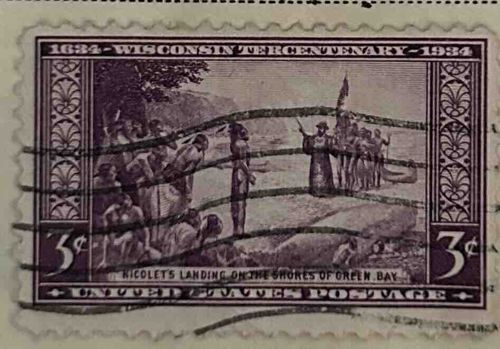
This item is a 1934 United States postage stamp commemorating the Wisconsin Tercentenary, specifically depicting 'Nicolet's Landing on the Shores of Green Bay'. The stamp is predominantly purple (violet) in color with a rectangular shape and perforated edges, indicating it was intended for postal use. The central image portrays a historical scene with several figures, including what appears to be Jean Nicolet, a French explorer, standing prominently with his arms outstretched, facing a group of Native Americans. Another figure stands by a canoe on the water. The scene is set on a shoreline with some distant trees or foliage visible. The border of the stamp features decorative neoclassical or art deco-inspired patterns on both vertical sides, with prominent '3¢' denominations in the lower left and right corners. At the top, the inscription reads '1634 - WISCONSIN TERCENTENARY - 1934', and below the central image, 'NICOLET'S LANDING ON THE SHORES OF GREEN BAY'. The bottom edge of the stamp clearly shows 'UNITED STATES POSTAGE'. The stamp appears to be 'used' as it has postmarks (cancelations) across it, specifically several wavy horizontal lines in a dark ink that obscure parts of the central image and text. The perforations around the edges seem generally intact, though some wear or irregularities might be present due to handling and cancellation. The overall condition, while used, appears to be fair to good for a stamp of this age, with the primary details of the design still discernible despite the postmark.
AI Appraisal Report
Based on my visual examination of the provided image, this is a 1934 United States 3-cent Wisconsin Tercentenary stamp, depicting 'Nicolet's Landing'. The design is clear, and it is identifiable as Scott #739. The stamp is clearly *used*, evidenced by distinct wavy cancellation lines across the central image and text. This immediately places its value significantly lower than an unused (mint) example.
From the image, the perforations appear intact, and the centering seems fair for a stamp of this era, not significantly off-center. The color saturation, despite the postmark, looks typical for this issue. However, given it is a used copy of a very common commemorative stamp, its value is inherently low. These stamps were produced in large quantities (over 50 million issued) and are readily available.
Market conditions for common U.S. commemoratives from the 1930s that are in used condition are generally soft. There is low demand for individual used copies of common issues, typically sought by beginner collectors or those filling spaces in albums. Rarity is not a factor here; this stamp is abundant.
Factors impacting value: The cancellation, while obscuring the image, does not appear excessively heavy or smudged, which is a minor positive. However, its 'used' status, combined with the stamp's commonality, are the primary determinants of its low value.
Limitations: My assessment of condition is based solely on the image. Without a physical examination, I cannot definitively assess paper integrity, gum condition (though irrelevant for a used stamp's face value), minor creases, toning, or hidden imperfections that could further affect its actual market value. Authenticity based on the image is confirmed for the stamp type, but microscopic examination for printing errors or nuanced condition issues would require in-person inspection.