AI estimate as of October 7, 2025 · verify with a professional before acting
AI-Generated · Verify before acting
Everything on this page is generated by AI for informational purposes only. AI can make mistakes — the AI may misidentify items or misattribute them (artist, maker, brand, designer, origin, era). This is not an official valuation and should not be used for insurance, sale, tax, estate, legal, or lending purposes — or any decision requiring a certified appraisal. It is not an authoritative claim about any person, brand, or rights holder — do not share or rely on it as a factual statement about a third party. Always consult qualified professionals before making financial decisions.
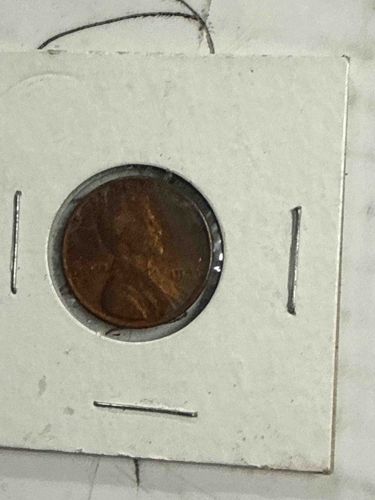
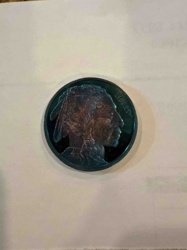
The item is a United States Lincoln Wheat Cent, likely from the 1940s based on the visible '194' of the date, encased within a cardboard 2x2 coin holder with a clear Mylar window. The coin itself exhibits a reddish-brown patina, consistent with aged copper coinage, indicating that it has not been cleaned. The obverse prominently features the profile bust of Abraham Lincoln, although the fine details of his portrait show some wear, particularly on the higher points such as the cheekbone and hair. The 'LIBERTY' motto above his head is somewhat obscured by the coin's coloring and wear, while the date '194X' is partially discernable at the bottom. The condition of the coin appears to be circulated, but not heavily abraded, suggesting moderate wear from use. There are no obvious deep scratches, dents, or significant corrosion visible from this angle, though the surface shows some minor specks and potentially some environmental toning or residue within the protective Mylar. The protective 2x2 holder is made of white cardboard, folded and stapled on all four sides to secure the coin. The staples are visible at the corners, indicating a standard, commercially available coin storage method. The cardboard holder itself shows some minor handling wear, dirt, and light creases, consistent with an item that has been stored or moved over time. The clear Mylar window holds the coin in place, preventing direct contact with the environment, though some dust or particles may be present on its surface or trapped within the holder. The overall visual quality of the coin suggests a standard issue, non-proof Lincoln Cent from the mid-20th century. Without a view of the reverse and a clearer image of the full date and mint mark, specific identification is limited, but the 'Wheat Cent' design is clearly visible from the portrait and general aesthetic.
AI Appraisal Report
I have examined the provided image of this 1940s Lincoln Wheat Cent in a 2x2 coin holder. Based on the visible '194' of the date and the clear Wheat Cent design elements, its authenticity as a genuine US Lincoln Cent from the mid-20th century is highly probable. The coin displays an even reddish-brown patina, consistent with uncleaned, circulated copper. Wear is evident on Lincoln's portrait, particularly on high points like the cheek and hair, placing its condition squarely in the 'Good' to 'Very Good' range (G-VG). There are no overt signs of damage like deep scratches or corrosion, though minor specks and possible toning are visible. The standard stapled 2x2 holder is a common, inexpensive storage method, indicating the coin is likely not a high-value rarity.
Market conditions for common date circulated Wheat Cents are generally low. These coins were produced in the billions, and even in lower circulated grades, their individual monetary value is minimal. Comparables for similar coins typically trade for mere cents above face value. Demand for common 1940s Wheat Cents in G-VG condition is primarily from new collectors or those filling out basic albums, leading to very low rarity considerations.
Factors significantly impacting value involve specific dates, mint marks (which are not visible), and higher uncirculated grades – none of which appear to be the case here. Without a clearer image of the full date and mint mark, I cannot pinpoint specific rarity.
Limitations: My authentication is based purely on visual inspection of the image. A full physical examination would be necessary to confirm the exact date and mint mark, assess any hidden damage or environmental issues, and verify weight and diameter. Without this, and specific provenance, I cannot definitively rule out alterations, although unlikely for a coin of this apparent value. However, based on the visible characteristics, it appears to be a very common circulated Wheat Cent.