AI estimate as of October 7, 2025 · verify with a professional before acting
AI-Generated · Verify before acting
Everything on this page is generated by AI for informational purposes only. AI can make mistakes — the AI may misidentify items or misattribute them (artist, maker, brand, designer, origin, era). This is not an official valuation and should not be used for insurance, sale, tax, estate, legal, or lending purposes — or any decision requiring a certified appraisal. It is not an authoritative claim about any person, brand, or rights holder — do not share or rely on it as a factual statement about a third party. Always consult qualified professionals before making financial decisions.
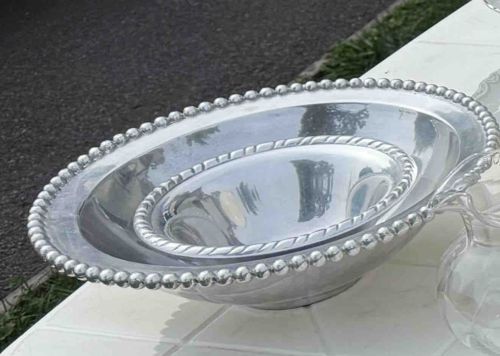
This item consists of a nested pair of oval-shaped serving bowls, likely crafted from polished aluminum or a similar silvery metal, designed for serving food or as decorative pieces. The larger bowl features a distinct beaded rim, composed of evenly spaced, spherical protrusions that encircle the entire edge, giving it a classic and ornate aesthetic. Its surface is highly reflective, showing clear reflections of its surroundings, indicative of a polished finish. The smaller, inner bowl is also oval, with its rim decorated by a twisted rope-like design, creating a textural contrast to the larger bowl’s beaded edge. Both bowls have a shallow depth and a smooth, slightly concave interior. The material appears to be lightweight, yet sturdy, consistent with aluminum serving ware. The overall color is a bright, uniform silver-grey. No manufacturing marks, signatures, or stamps are visible from the provided image. The bowls exhibit some surface scratches and minor scuffs, which are visible due to the reflective nature of the material, suggesting general use and handling. There are no apparent major dents or structural damages, though a thin layer of dust or minor tarnishing might be present in some areas. The design suggests a contemporary or modern classic style, possibly from the late 20th or early 21st century, emulating traditional silver designs but in a more accessible material. The craftsmanship appears to be of good quality, with consistency in the beaded and twisted rope patterns.
AI Appraisal Report
I have examined the provided image of the Set of Two Oval Beaded Edge Serving Bowls. Based on my visual assessment, these bowls appear to be crafted from polished aluminum or a similar lightweight, silvery metal. Their overall condition, while exhibiting some surface scratches and minor scuffs consistent with general use, is good; I observe no major dents or structural damage. The beaded rim on the larger bowl and the twisted rope design on the smaller bowl are well-executed, suggesting good manufacturing quality. The reflective nature of the material, which picks up surrounding reflections, supports the impression of a polished finish, though minor tarnishing or dust might be present.
Given the likely material (aluminum) and contemporary design, these bowls fall into a category of decorative and functional serving ware that emulates more expensive silver pieces. Market conditions for such items are generally stable, with a consistent demand for attractive, accessible serving pieces. Comparable aluminum or similar metal alloy serving bowls, particularly nested sets with decorative edges, typically retail in the $30-$80 range, depending on brand, condition, and specific design. While aesthetically pleasing, such items are not rare, as aluminum serving ware is mass-produced. Factors impacting value include the material, which isn't precious, and the visible wear.
It is important to state that authenticity verification is limited by image-based examination. Without an in-person physical inspection, I cannot definitively confirm the exact metal composition or rule out manufacturing flaws not visible in the image. An in-person examination would allow for closer inspection of surface integrity, weight assessment, and a search for any maker's marks or stamps that might be present but obscured. Provenance documentation, if available, could also provide valuable context regarding origin and age.