AI estimate as of July 19, 2025 · verify with a professional before acting
AI-Generated · Verify before acting
Everything on this page is generated by AI for informational purposes only. AI can make mistakes — the AI may misidentify items or misattribute them (artist, maker, brand, designer, origin, era). This is not an official valuation and should not be used for insurance, sale, tax, estate, legal, or lending purposes — or any decision requiring a certified appraisal. It is not an authoritative claim about any person, brand, or rights holder — do not share or rely on it as a factual statement about a third party. Always consult qualified professionals before making financial decisions.
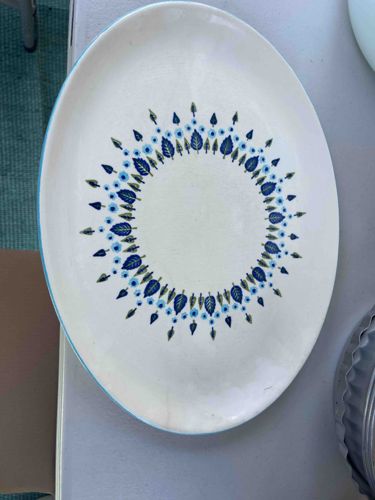
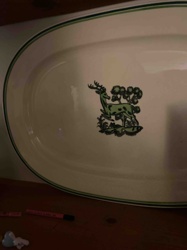
This is a vintage ceramic serving platter, likely made of earthenware or stoneware, featuring an off-white or cream-colored glaze. The platter has an elongated oval shape with gently curved edges, giving it a soft, organic feel. A distinctive pattern is centrally placed, forming an open ring or wreath design. This pattern consists of alternating elements: darker blue leaves, smaller light blue circular shapes, and dark blue elongated teardrop or spear-like elements, all arranged radially. The design has a folk-art or mid-century modern aesthetic, possibly suggesting an origin from the 1950s to 1970s. The rim of the platter features a thin, light blue accent line, adding a subtle touch of color and defining its perimeter. There is visible crazing on the surface of the glaze, which appears as a network of fine cracks, indicative of its age and the natural aging process of the ceramic material. This crazing is evenly distributed and does not appear to be significant damage, but rather a common characteristic of older glazed pottery. No obvious chips, cracks, or repairs are visible from the provided image. There are no discernible maker's marks or signatures visible from this angle. The quality of craftsmanship appears to be standard for mass-produced dinnerware of its era, with a charming hand-painted or decal-applied aesthetic to the central design.
AI Appraisal Report
Based on my visual examination of the provided image, this Vintage Oval Ceramic Serving Platter with a Blue Leaf and Dot Pattern appears to be in good vintage condition. The presence of crazing, a network of fine cracks in the glaze, is consistent with its age and common in earthenware or stoneware from the mid-20th century (likely 1950s-1970s). This crazing is generally considered a sign of age rather than significant damage, provided it doesn't compromise the structural integrity, which it doesn't appear to from the image. No chips, cracks, or repairs are evident.
Authenticity, based solely on visual inspection, places it within the described vintage period. The folk-art/mid-century aesthetic aligns with dinnerware styles of that era. However, without maker's marks, provenance documentation, or in-person examination, definitive attribution to a specific manufacturer or precise date is impossible. An in-person inspection would allow for tactile assessment of the ceramic body, glaze quality, and a thorough search for any hidden marks. Scientific testing, such as thermoluminescence dating, could ascertain age more precisely but is typically not economically viable for items of this value.
Market conditions for vintage serving platters of this type are generally stable but not highly speculative. While attractive, the design is not exceptionally rare, and similar pieces from various manufacturers can be found. Demand is primarily from collectors of vintage kitchenware, mid-century modern enthusiasts, or those seeking decorative, functional pieces for their homes. Factors impacting value include its good condition despite crazing, the appealing color palette, and the charming design. The lack of a discernible maker's mark limits its appeal to brand-specific collectors, thus tempering its top-end value.
Comparables suggest similar unmarked or mass-produced vintage serving platters typically sell in the range of $20 to $50, depending on design appeal and condition.