AI estimate as of October 11, 2025 · verify with a professional before acting
AI-Generated · Verify before acting
Everything on this page is generated by AI for informational purposes only. AI can make mistakes — the AI may misidentify items or misattribute them (artist, maker, brand, designer, origin, era). This is not an official valuation and should not be used for insurance, sale, tax, estate, legal, or lending purposes — or any decision requiring a certified appraisal. It is not an authoritative claim about any person, brand, or rights holder — do not share or rely on it as a factual statement about a third party. Always consult qualified professionals before making financial decisions.
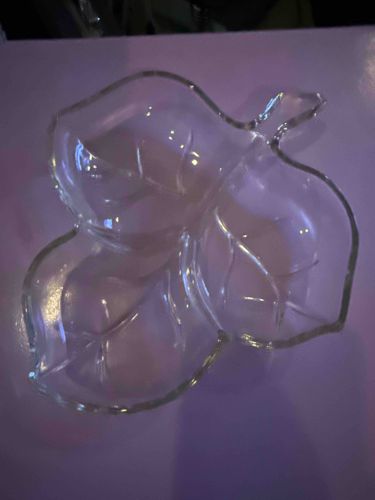
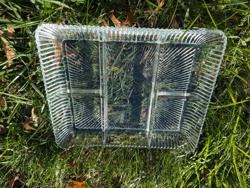
This item is a clear glass, triple-compartment serving dish, molded into the shape of three overlapping leaves. The design features three distinct depressions, each taking the form of a leaf, with clearly defined veins embossed on the interior of each leaf-shaped section. The leaves appear to be connected at a central point, forming a coherent, organic silhouette. The glass is transparent, allowing light to pass through, and exhibits a smooth, polished surface with gentle curves defining the edges of each compartment. The quality of the glass appears to be standard, possibly machine-pressed, given the uniformity of the design. There are no visible chips, cracks, or significant abrasions on the surface, suggesting good overall condition. No specific maker's marks, signatures, or stamps are discernible from the provided image. The item likely dates from the mid to late 20th century, a period when such decorative and functional glass serving ware was popular. Its clear construction makes it versatile for various table settings and uses, such as serving appetizers, nuts, candies, or relishes. The three-part division indicates its utility for holding different items without them mixing. The craftsmanship is functional and aesthetically pleasing, with the leaf motif adding a touch of nature-inspired decor.
AI Appraisal Report
I have virtually examined this Clear Glass Triple Leaf Divided Dish based on the provided image. The condition appears to be very good; I see no visible chips, cracks, or significant abrasions, which is a positive factor for items of this nature. The authenticity, based on visual cues, suggests it is indeed a clear glass serving dish as described, likely machine-pressed due to the uniformity. However, without tactile examination, I cannot definitively confirm the subtle nuances of the glass quality or detect hairline flaws.
From a market perspective, this type of clear glass serving ware from the mid to late 20th century is relatively common. While the leaf motif is aesthetically pleasing, it doesn't represent a unique or highly sought-after design element that would command a premium. Demand for such functional, decorative glass is stable but not particularly high among collectors, and it is not considered rare. Factors impacting value are primarily condition and popular appeal for vintage home decor. Had it been a rare maker, such as Fostoria or Duncan & Miller, or a unique pattern, the value would be higher. However, without any discernible maker's marks, it is considered generic.
To fully verify authenticity and precise dating, a physical inspection would be essential to check for subtle manufacturing marks, glass characteristics (e.g., presence of fire polishing marks, mold lines indicating pressing), and to rule out contemporary reproductions. Provenance documentation, though unlikely for an item of this type, would also be beneficial but is not expected. Given its likely mass-produced nature and absence of identifiable premium characteristics, the value remains modest.