AI estimate as of September 30, 2025 · verify with a professional before acting
AI-Generated · Verify before acting
Everything on this page is generated by AI for informational purposes only. AI can make mistakes — the AI may misidentify items or misattribute them (artist, maker, brand, designer, origin, era). This is not an official valuation and should not be used for insurance, sale, tax, estate, legal, or lending purposes — or any decision requiring a certified appraisal. It is not an authoritative claim about any person, brand, or rights holder — do not share or rely on it as a factual statement about a third party. Always consult qualified professionals before making financial decisions.
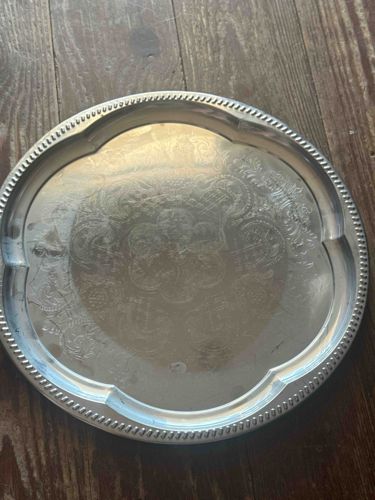
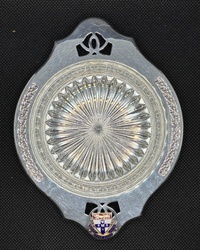
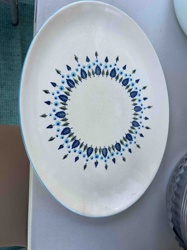
This appears to be a vintage silverplate round serving tray, likely dating from the mid-20th century, possibly earlier given the ornate detailing. The tray features a scalloped or shaped rim, which is further embellished with a 'rope' or 'beaded' edge design, adding a decorative touch. The material is silverplate, evident from the metallic luster and the typical style of such serving wares. The primary surface of the tray is adorned with an intricate chased or engraved pattern, possibly a floral and scroll motif, which covers the entire central area. This decorative work indicates a degree of craftsmanship and was a common feature on elegant serving pieces. Physically, the tray is round with a slightly raised edge, suggesting it's designed for serving items, preventing them from sliding off easily. The color is a bright, reflective silver, though some areas show slight dullness or minor tarnishing consistent with age and use. Condition-wise, there are visible scratches and scuffs on the mirrored surface, typical wear and tear from years of service. There doesn't appear to be any significant damage like dents or buckling, but a minor irregularity in the beaded rim is visible in one of the close-up crops, suggesting minor wear or a manufacturing imperfection. No specific maker's marks or signatures are discernible from the provided images, which might be on the underside. The overall style is classic and ornate, often associated with traditional dining or entertaining.
AI Appraisal Report
Upon visual examination of the provided images, I assess this silverplate round serving tray. The item appears to be authentic silverplate, likely mid-20th century, consistent with the ornate chased design, scalloped rim, and 'rope' or 'beaded' edge. The craftsmanship of the chased floral and scroll motif is well executed, adding to its decorative appeal.
Condition-wise, the tray exhibits typical wear for its age and material. There are visible scratches and scuffs on the mirrored surface, which is common with used silverplate serving pieces. Small areas of dullness or minor tarnishing are also present, which can usually be addressed with proper cleaning. I observe a minor irregularity on the beaded rim, which could be a manufacturing imperfection or minor wear, but no significant dents or buckling are apparent, indicating reasonable care over its lifetime.
In terms of market conditions, vintage silverplate serving trays are quite common. While ornate designs are desirable, the market for silverplate generally holds modest value compared to sterling silver. Comparables in similar condition typically sell in the $40-$70 range, reflecting its decorative rather than intrinsic material value. Demand is moderate, primarily from collectors or individuals seeking decorative accents for traditional settings. Rarity is low as similar items were mass-produced. The absence of discernible maker's marks is a significant factor impacting value, as identifiable manufacturers can sometimes command slightly higher prices.
Limitations in authenticity verification are inherent when appraising from images alone. Without physical inspection, I cannot confirm the exact composition of the silverplate, the depth of the chasing, or definitively rule out any repairs or underlying structural issues. Full authentication would require in-person examination to assess weight, structural integrity, and to search for any hidden maker's marks, as well as potentially scientific testing if the material composition were ever in question. Provenance documentation, though unlikely for an item of this type, would also provide additional context.