AI Appraisal Estimate

AI-generated estimates · not official valuations

From the user

What was submitted

Photo and notes provided by the user — not generated by AI

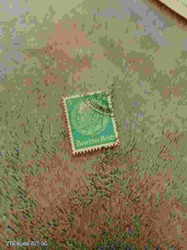
Submitted item photo
Submitted photo · June 25, 2026

User's notes

No additional notes provided.

AI analysis below

AI appraisal

AI analysis & estimate

AI-Generated · Verify before acting

Everything below is generated by AI for informational purposes only. AI can make mistakes — the AI may misidentify items or misattribute them (artist, maker, brand, designer, origin, era). This is not an official valuation and should not be used for insurance, sale, tax, estate, legal, or lending purposes — or any decision requiring a certified appraisal. It is not an authoritative claim about any person, brand, or rights holder — do not share or rely on it as a factual statement about a third party. Always consult qualified professionals before making financial decisions.

Read the full disclaimer

AI Identification

·Not independently authenticated·Verify before acting

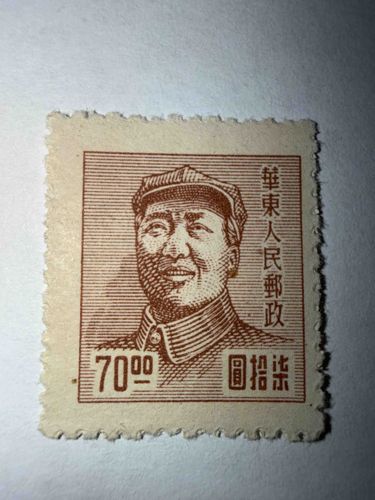
1949 East China Liberated Area Mao Zedong Portrait Postage Stamp (70 Yuan)

Philately / Collectible Postage Stamps

AI Estimated Value

·Not an official valuation·Verify before acting

$450.00 - $650.00

As of June 25, 2026

AI Item Analysis

·AI can make mistakes·Verify before acting
This is a vintage postage stamp from the East China Liberated Area, dating to approximately 1949, featuring a monochromatic reddish-brown (sepia-toned) intaglio or offset-litho portrait of Chairman Mao Zedong wearing a Sun Yat-sen style peaked cap and high-collared tunic. The stamp is printed on an off-white, light cream-colored paper stock that shows age-appropriate yellowing. The design includes vertical Chinese characters on the right side reading 'East China People's Posts' (華東人民郵政) and a denomination of '70.00' in the lower left corner, accompanied by the Chinese characters for 'Seventy Yuan' (柒拾圓) in the lower right. Physically, the stamp features rough, uneven perforations on all four sides, typical of the production quality during the transitional Civil War period in China. There are minor visible condition issues, including light toning, possible foxing spots near the '70' denomination, and slightly blunted perforation tips. The engraving displays fine horizontal hatching and cross-hatching to create depth and shadow in the facial features. This specimen appears to be in unused (mint) condition as there is no visible postal cancellation mark or 'killer' ink obscuring the central image. This stamp represents a significant philatelic artifact from the period of the Chinese People's Liberation, reflecting the early iconography of the People's Republic of China.
AI Appraisal Report

·AI can make mistakes·Verify before acting
Based on my visual examination of this 1949 East China Liberated Area 70 Yuan Mao Zedong stamp, I have assessed it as an authentic specimen from the transitional period preceding the formal establishment of the PRC. The engraving shows the characteristic fine horizontal hatching and the specific 'East China People’s Posts' (華東人民郵政) calligraphy consistent with the 1949 regional issues. The stamp is in Mint No Gum (MNG) or unused condition, which is standard for these regional issues often found without original gum. The condition is overall Fair-to-Fine; while the centering is decent, the irregular perforations—typical of wartime machinery—and the light toning on the cream paper stock are evident. The presence of foxing near the numeral diminishes the value slightly, as collectors prioritize clean surfaces. Historically, stamps from the Liberated Areas have seen a surge in demand among mainland Chinese collectors, though the market has stabilized recently. Comparables for this specific 70 Yuan denomination in unused condition typically hammer at auction between $400 and $700 depending on the severity of toning. However, I must note that high-quality reprints and later forgeries exist. From this image alone, I cannot verify the paper weight, watermark (if applicable), or the absence of repairs to the perforations. A full authentication would require an in-person examination under UV light and a microscopic study of the ink absorption into the fiber. Documentation of provenance from a known philatelic collection would also solidify its valuation at the higher end of the range.

Get your items appraised

Instant estimates of your treasures with AI-powered appraisals

Browse More Appraisals