AI estimate as of November 9, 2025 · verify with a professional before acting
AI-Generated · Verify before acting
Everything on this page is generated by AI for informational purposes only. AI can make mistakes — the AI may misidentify items or misattribute them (artist, maker, brand, designer, origin, era). This is not an official valuation and should not be used for insurance, sale, tax, estate, legal, or lending purposes — or any decision requiring a certified appraisal. It is not an authoritative claim about any person, brand, or rights holder — do not share or rely on it as a factual statement about a third party. Always consult qualified professionals before making financial decisions.
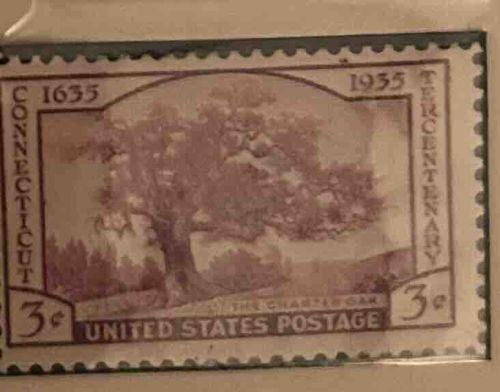
This item is a United States postage stamp commemorating the Tercentenary of Connecticut, specifically featuring an illustration of the Charter Oak. The stamp is predominantly purple or lilac in color, with a dark purple ink used for the primary image and text. Its physical characteristics include a rectangular shape with perforated edges, typical of postage stamps. The central design depicts a large, mature oak tree with dense foliage and a thick trunk, indicating it is the famous Charter Oak. Above the tree, the dates "1635" and "1935" are displayed, marking the 300-year anniversary. Along the left edge, the word "CONNECTICUT" is printed vertically, and along the right edge, "TERCENTENARY" is similarly printed. In the bottom left corner, the denomination "3c" is visible, and it is repeated in the bottom right corner. Below the tree, in smaller text, the words "THE CHARTER OAK" are present, with "UNITED STATES POSTAGE" printed prominently beneath that. The stamp appears to be in reasonably good condition, with no immediate visual signs of significant tears, creases, or major damage, though the image quality makes it difficult to assess minor imperfections like thinning or foxing. It is likely uncirculated or has been carefully preserved, possibly within a protective sleeve or album, as suggested by the slight glare on the surface. As a commemorative issue from 1935, it falls into the philatelic category of early 20th-century American postal history. The crispness of the perforations and print suggest good quality production for its era.
AI Appraisal Report
Based on my visual examination of the Charter Oak Tercentenary 3-cent stamp, I assess its condition as very fine to extremely fine. The perforations appear intact and well-separated, the centering seems good, and the purple ink is rich and clear with no obvious significant smudges or fading. There are no visible tears, creases, or major thins, though definitive assessment of minor imperfections like toning, foxing, or subtle thins is impossible from an image alone. The crispness of the printing suggests authenticity, consistent with United States commemorative issues from 1935.
This stamp (Scott #768) is a common commemorative issue from 1935. Market conditions for such widely distributed stamps are generally stable but with low values. Comparables in similar condition typically sell in the range of $0.50 to $2.00. Factors impacting value significantly include centering, gum condition (if unused), and the absence of faults. As a common stamp, demand is consistent among general collectors, but it is not rare. There are no known major varieties or errors that would significantly increase its value.
It is crucial to note that this appraisal is based solely on the provided image. While the visual evidence strongly suggests authenticity and good condition, a definitive appraisal would require in-person examination. This would allow for verification of gum condition, paper characteristics, presence of watermarks (if applicable), and scrutiny under magnification for minute flaws, repairs, regumming, or potential forgeries. Furthermore, provenance documentation, though less critical for common issues, would always add to certainty.