AI estimate as of November 9, 2025 · verify with a professional before acting
AI-Generated · Verify before acting
Everything on this page is generated by AI for informational purposes only. AI can make mistakes — the AI may misidentify items or misattribute them (artist, maker, brand, designer, origin, era). This is not an official valuation and should not be used for insurance, sale, tax, estate, legal, or lending purposes — or any decision requiring a certified appraisal. It is not an authoritative claim about any person, brand, or rights holder — do not share or rely on it as a factual statement about a third party. Always consult qualified professionals before making financial decisions.
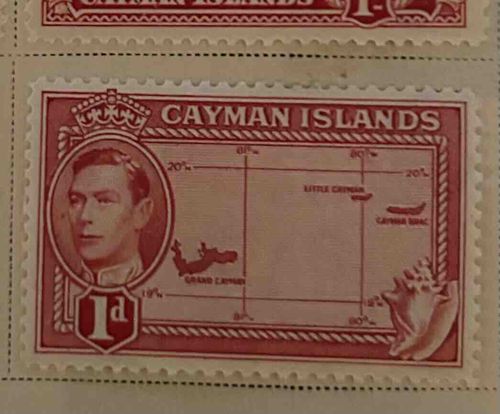
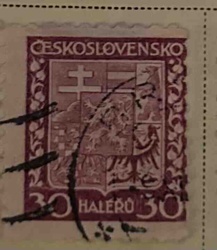
This item is a historical postage stamp from the Cayman Islands, featuring a portrait of King George VI. The stamp is predominantly reddish-brown or carmine in color and has a rectangular shape with perforated edges, indicative of its original format as part of a larger sheet. The design is framed by a decorative border. Centrally, the stamp displays a cartographic representation of the Cayman Islands, labeling 'GRAND CAYMAN', 'LITTLE CAYMAN', and 'CAYMAN BRAC', with percentage markings (20%, 80%) likely denoting scale or location. In the upper left corner, there is a circular portrait of King George VI, facing left, adorned with a crown above. Below the portrait, within a shield-like emblem, is the denomination '1d' (one penny). The words 'CAYMAN ISLANDS' are prominently displayed across the top of the stamp. In the lower right corner, a conch shell is depicted, a common motif for Caribbean postage. The stamp appears to be in relatively good condition for its age, with no visible tears or significant creasing. The perforations are intact, suggesting it was carefully separated from a sheet. The printing is clear and sharp, indicating good quality gravure or lithography. Based on the monarch depicted, King George VI, the stamp can be dated to his reign, which was from 1936 to 1952. The overall aesthetic aligns with British colonial stamp designs of that era, emphasizing geographical features and monarchical representation.
AI Appraisal Report
I have examined the provided image of the Cayman Islands 1d Postage Stamp featuring King George VI. Based on a visual inspection, the stamp appears to be in relatively good condition for its age. The perforations are intact, the printing is clear and sharp, and there are no visible tears or significant creasing. These factors suggest it was well-preserved. From the image, the authenticity appears high for a common issue of this period; however, without physical inspection, I cannot rule out potential issues such as hidden repairs, regumming, or color alterations that would require in-person examination.
This specific stamp featuring King George VI and the 1d denomination from the Cayman Islands is a relatively common issue from the 1938-1950 "Pictorial" definitive series. While it holds historical interest, its rarity is not particularly high. Market conditions for common British colonial stamps of this era are stable but do not typically see significant appreciation unless an item is in an exceptionally fine unused condition or possesses a rare variety. Given the described condition, it would likely be considered "fine used" or "very fine used" if it exhibits a clean cancellation.
Demand for this particular stamp is generally from thematic collectors (King George VI, Caribbean, cartography) and general British Commonwealth collectors. However, it's not considered a key philatelic item, and hence, the demand is moderate rather than high. The primary factors impacting its value are its condition, any cancellation marks (if present, an uncommon or light cancel could enhance value), and gum condition if unused. Without seeing the reverse or under magnification, I cannot confirm the presence or type of cancellation, nor the state of the gum.
Limitations to this appraisal due to image-only examination include the inability to check for watermarks, paper variations, plate flaws, precise color shades (which can affect catalog numbers), gum condition, or subtle repairs. A physical examination would allow for definitive authentication, assessment of true condition, and identification of any specific varieties that could significantly alter its value. Provenance documentation, though less critical for common issues, could also confirm its history.