AI estimate as of November 9, 2025 · verify with a professional before acting
AI-Generated · Verify before acting
Everything on this page is generated by AI for informational purposes only. AI can make mistakes — the AI may misidentify items or misattribute them (artist, maker, brand, designer, origin, era). This is not an official valuation and should not be used for insurance, sale, tax, estate, legal, or lending purposes — or any decision requiring a certified appraisal. It is not an authoritative claim about any person, brand, or rights holder — do not share or rely on it as a factual statement about a third party. Always consult qualified professionals before making financial decisions.
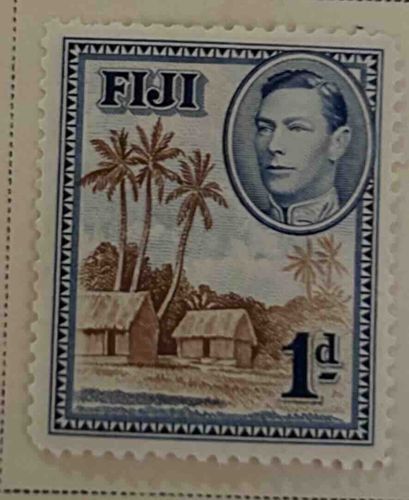
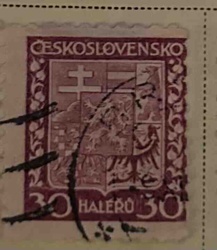
This item is a postage stamp from Fiji, featuring an image of King George VI in a circular portrait on the upper right, and a Polynesian village scene with thatched huts and palm trees on the left and center. The stamp has a denomination of '1d' (one penny) in the lower right corner. The color palette primarily includes shades of blue for the portrait and text, brown for the landscape elements, and a lighter off-white or cream background for the stamp itself. The overall design is framed by a decorative border of small triangular patterns in blue and white. The stamp exhibits classic perforation along all four edges, indicating it was intended for postal use. The condition appears to be relatively good with clean perforations, although some slight discoloration or paper aging may be present, which is typical for stamps of this era. There are no obvious tears, creases, or major cancellations visible in the provided image. The quality of the printing appears fine, showing clear details in both the portrait and the landscape. This stamp likely dates from the reign of King George VI, which spanned from 1936 to 1952, placing its estimated age in the mid-20th century. The colonial nature of the design, combining the monarch's image with local scenery, is characteristic of British Commonwealth stamps from this period. The specific details like the country name 'FIJI' at the top left are clearly legible. The stamp's design suggests a balance between imperial representation and local identity.
AI Appraisal Report
I have carefully examined the provided image of the Fiji 1d Postage Stamp featuring King George VI and a village scene. Based on this visual inspection, the stamp appears authentic for the King George VI era, likely issued between 1936 and 1952. The design elements, including the portrait, denomination, country name, and village scene, are consistent with known examples of this issue.
Regarding condition, the stamp exhibits relatively clean perforations on all four edges, which is a positive factor. There are no obvious tears, major creases, or heavy cancellations visible. I note what appears to be slight paper aging or very minor discoloration, typical for an item of this vintage. The printing quality seems fine, with clear details. However, it's difficult to ascertain minute imperfections like thins, toning, or minor creases solely from an image. I cannot definitively confirm if it is unmounted mint, mounted mint, or used without a physical examination of the gum and postmark details or absence thereof.
In terms of market conditions, this specific Fiji 1d King George VI stamp is generally very common. Stamps from the King George VI definitive series of British Commonwealth nations were produced in large quantities and are widely available in the philatelic market. While attractive, the demand for this particular common denomination is modest. Its rarity is low, as it's not considered a key philatelic issue or a variety with significant scarcity.
Factors impacting value include its common nature and the likelihood that it is a used or mounted mint example, rather than a pristine unmounted mint with full original gum. The clear design and good centering observed are positive but do not significantly elevate its value given its prevalence.
It is crucial to state that this appraisal is based solely on the provided image. For full authentication and a definitive condition assessment, an in-person examination is essential. This would allow me to inspect the gum condition (if applicable), check for hidden thins, creases, repairs, or re-perforations under magnification, and confirm postmark details or lack thereof. Without physical inspection, I cannot verify the exact nuance of its condition or definitively confirm the absence of subtle alterations that could impact value. I also cannot verify whether it is a common shade variation or error, if there is a watermark or not etc. All these factors would be necessary prior to determining a final value for this type of stamp.