AI Appraisal Estimate

AI-generated estimates · not official valuations

From the user

What was submitted

Photo and notes provided by the user — not generated by AI

Submitted item photo
Submitted photo · June 6, 2026

User's notes

No additional notes provided.

AI analysis below

AI appraisal

AI analysis & estimate

AI-Generated · Verify before acting

Everything below is generated by AI for informational purposes only. AI can make mistakes — the AI may misidentify items or misattribute them (artist, maker, brand, designer, origin, era). This is not an official valuation and should not be used for insurance, sale, tax, estate, legal, or lending purposes — or any decision requiring a certified appraisal. It is not an authoritative claim about any person, brand, or rights holder — do not share or rely on it as a factual statement about a third party. Always consult qualified professionals before making financial decisions.

Read the full disclaimer

AI Identification

·Not independently authenticated·Verify before acting

Framed Chinese Silk Embroidery Panel

Asian Art and Textiles

AI Estimated Value

·Not an official valuation·Verify before acting

$400 - $600

As of June 6, 2026

AI Item Analysis

·AI can make mistakes·Verify before acting
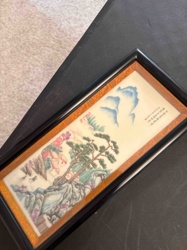
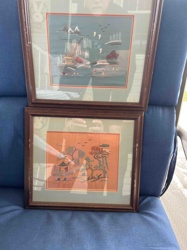
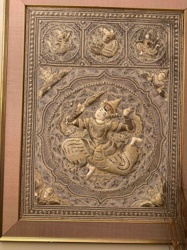
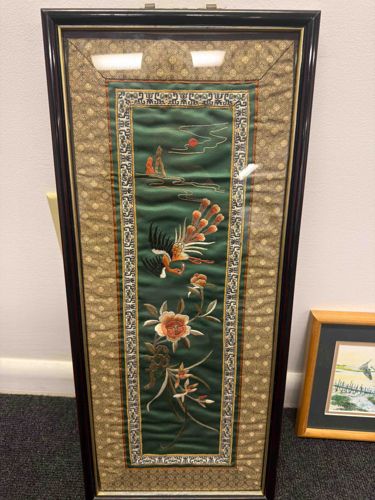
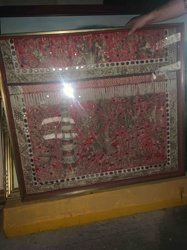
This is a vertical rectangular Chinese silk embroidery panel, likely dating from the mid-20th century. The central scene is hand-stitched on a vibrant emerald green silk satin ground, featuring a symbolic phoenix in flight above a flowering peony branch, with a red sun and stylized clouds in the upper register. The embroidery utilizes a variety of techniques including satin stitch and long-and-short stitch to create texture and depth in the feathers and petals. The colors remain relatively bright, showing shades of orange, coral, white, and gold thread. The central panel is framed by a white and blue wave-pattern border, which is itself mounted on a wide mat of gold-colored brocade fabric with a repeating geometric pattern. The piece is housed in a modern dark-stained wood or faux-wood frame with a thin gold-toned inner lip, protected by glass. The overall construction appears to be for the decorative export market. Condition-wise, the silk ground shows some visible rippling or 'cockling,' which is common for older textiles that have moved against their backing. There are no immediate signs of significant staining or insect damage from this perspective, though some light fading to the thread may be present. The frame is in good condition with minor surface dust.
AI Appraisal Report

·AI can make mistakes·Verify before acting
I have conducted a visual analysis of this framed Chinese silk embroidery panel. Based on the stitching techniques and the character of the emerald green silk ground, I identify this as a mid-20th-century decorative piece intended for the export market. The iconography—featuring the phoenix and peony—is well-executed using satin stitches and gold-wrapped thread, symbolizing prosperity and grace. The presence of the patterned silk brocade mat and twentieth-century framing suggests a production period between 1940 and 1970. The condition is generally good for a textile of this age. While the colors remain vibrant, I noted visible 'cockling' or rippling of the silk. This indicates the textile is not fully tensioned or has reacted to humidity, which is a common age-related issue but slightly detracts from the aesthetic value. The frame shows no significant structural damage. In the current market, decorative Asian textiles of this period are common. Comparables at auction typically realize between $300 and $700 depending on the complexity of the needlework and the frame's condition. While the phoenix is a popular motif, this piece is not considered rare. The primary value drivers here are the size and the visual appeal of the vibrant green ground. Limitations: This appraisal is based solely on digital images. Without an in-person examination, I cannot verify the exact fiber composition (silk vs. rayon) or check the reverse for structural repairs or hidden foxing. To fully authenticate its age and provenance, a physical inspection of the thread twist and a UV light test to check for modern synthetic dyes would be required. Documentation of purchase history would also be beneficial to rule out late-20th-century mass-produced replicas.

Get your items appraised

Instant estimates of your treasures with AI-powered appraisals

Browse More Appraisals